تم الحل ✓
categoryالفيزياء
schoolبكالوريوس
event_available2026-07-14
السؤال
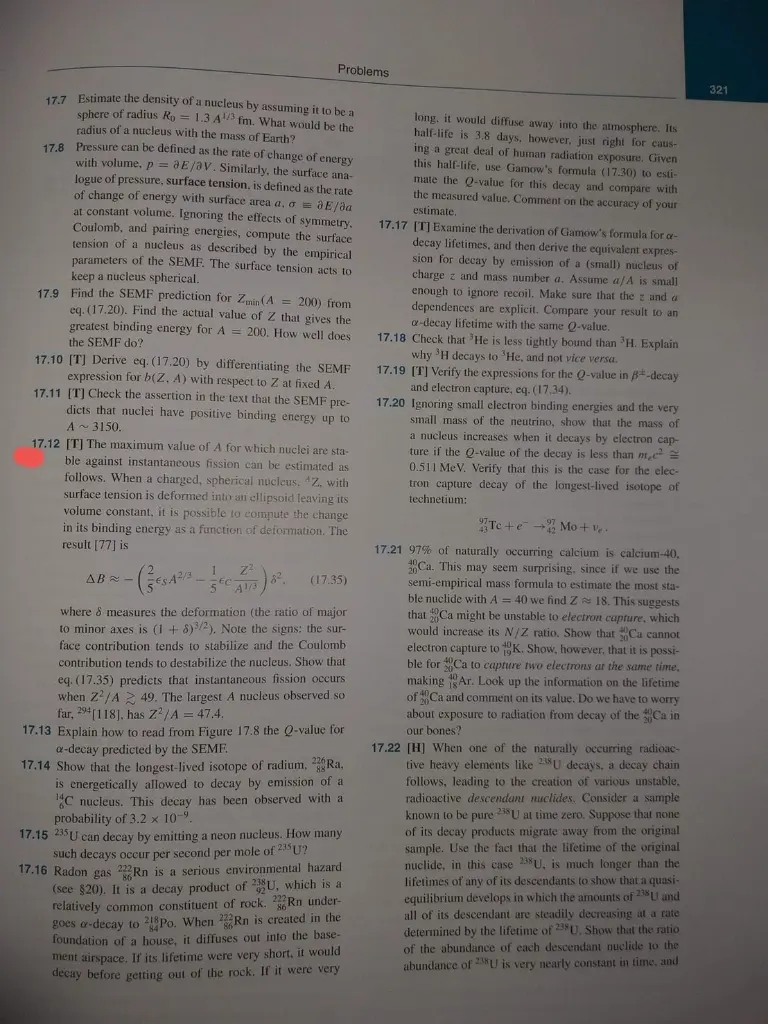
Transcribed Image Text:
Problems
17.7 Estimate the density of a nucleus by assuming it to be a
sphere of radius Ro=1.3 A1/3 fm. What would be the
radius of a nucleus with the mass of Earth?
17.8 Pressure can be defined as the rate of change of energy
with volume, p=E/av. Similarly, the surface ana-
logue of pressure, surface tension, is defined as the rate
of change of energy with surface area a, σ = 8E/aa
at constant volume. Ignoring the effects of symmetry,
Coulomb, and pairing energies, compute the surface
tension of a nucleus as described by the empirical
parameters of the SEMF. The surface tension acts to
keep a nucleus spherical.
17.9 Find the SEMF prediction for Zmin (A
= 200) from
eq. (17.20). Find the actual value of Z that gives the
greatest binding energy for A = 200. How well does
the SEMF do?
17.10 [T] Derive eq. (17.20) by differentiating the SEMF
expression for b(Z, A) with respect to Z at fixed A.
17.11 [T] Check the assertion in the text that the SEMF pre-
dicts that nuclei have positive binding energy up to
A 3150.
17.12 [T] The maximum value of A for which nuclei are sta-
ble against instantaneous fission can be estimated as
follows. When a charged, spherical nucleus, Z., with
surface tension is deformed into an ellipsoid leaving its
volume constant, it is possible to compute the change
in its binding energy as a function of deformation. The
result [77] is
AB≈-
1
EC
Z²
50 A1/3
82
(17.35)
where & measures the deformation (the ratio of major
to minor axes is (1 + 8)3/2). Note the signs: the sur-
face contribution tends to stabilize and the Coulomb
contribution tends to destabilize the nucleus. Show that
eq. (17.35) predicts that instantaneous fission occurs
when 22/A49. The largest A nucleus observed so
far, 294 [118], has Z²/A = 47.4.
17.13 Explain how to read from Figure 17.8 the Q-value for
a-decay predicted by the SEMF.
17.14 Show that the longest-lived isotope of radium, 22a,
is energetically allowed to decay by emission of a
1C nucleus. This decay has been observed with a
probability of 3.2 × 10⁻⁹.
17.15 235U can decay by emitting a neon nucleus. How many
such decays occur per second per mole of 235U?
17.16 Radon gas 22Rn is a serious environmental hazard
(see $20). It is a decay product of 238 U, which is a
relatively common constituent of rock. 222 Rn under-
goes a-decay to 218Po. When 222Rn is created in the
foundation of a house, it diffuses out into the base-
ment airspace. If its lifetime were very short, it would
decay before getting out of the rock. If it were very
long, it would diffuse away into the atmosphere. Its
half-life is 3.8 days, however, just right for caus-
ing a great deal of human radiation exposure. Given
this half-life, use Gamow's formula (17.30) to esti-
mate the Q-value for this decay and compare with
the measured value. Comment on the accuracy of your
estimate.
17.17 [T] Examine the derivation of Gamow's formula for a-
decay lifetimes, and then derive the equivalent expres-
sion for decay by emission of a (small) nucleus of
charge z and mass number a. Assume a/A is small
enough to ignore recoil. Make sure that the z and a
dependences are explicit. Compare your result to an
a-decay lifetime with the same Q-value.
17.18 Check that 'He is less tightly bound than 'H. Explain
why H decays to He, and not vice versa.
17.19 [T] Verify the expressions for the Q-value in B-decay
and electron capture, eq. (17.34).
17.20 Ignoring small electron binding energies and the very
small mass of the neutrino, show that the mass of
a nucleus increases when it decays by electron cap-
ture if the Q-value of the decay is less than m,c²
0.511 MeV. Verify that this is the case for the elec-
tron capture decay of the longest-lived isotope of
technetium:
Te+e Mo+ve.
17.21 97% of naturally occurring calcium is calcium-40,
20Ca. This may seem surprising, since if we use the
semi-empirical mass formula to estimate the most sta-
ble nuclide with A= 40 we find Z 18. This suggests
that Ca might be unstable to electron capture, which
would increase its N/Z ratio. Show that Ca cannot
electron capture to K. Show, however, that it is possi-
ble for Ca to capture two electrons at the same time,
making Ar. Look up the information on the lifetime
of Ca and comment on its value. Do we have to worry
about exposure to radiation from decay of the Ca in
our bones?
of
18
17.22 [H] When one of the naturally occurring radioac-
tive heavy elements like 238U decays, a decay chain
follows, leading to the creation of various unstable,
radioactive descendant nuclides. Consider a sample
known to be pure 238U at time zero. Suppose that none
of its decay products migrate away from the original
sample. Use the fact that the lifetime of the original
nuclide, in this case 238 U, is much longer than the
lifetimes of any of its descendants to show that a quasi-
equilibrium develops in which the amounts of 238U and
all of its descendant are steadily decreasing at a rate
determined by the lifetime of 238U. Show that the ratio
of the abundance of each descendant nuclide to the
abundance of 238U is very nearly constant in time, and
321
check_circle الجواب — حل مفصل خطوة بخطوة
hourglass_top
🔒
الحل الكامل متاح للمشتركين
اشترك في أرشيف الأسئلة لعرض هذا الحل وآلاف الحلول المفصلة خطوة بخطوة من معلمين معتمدين.