تم الحل ✓
categoryالفيزياء
schoolبكالوريوس
event_available2026-07-14
السؤال
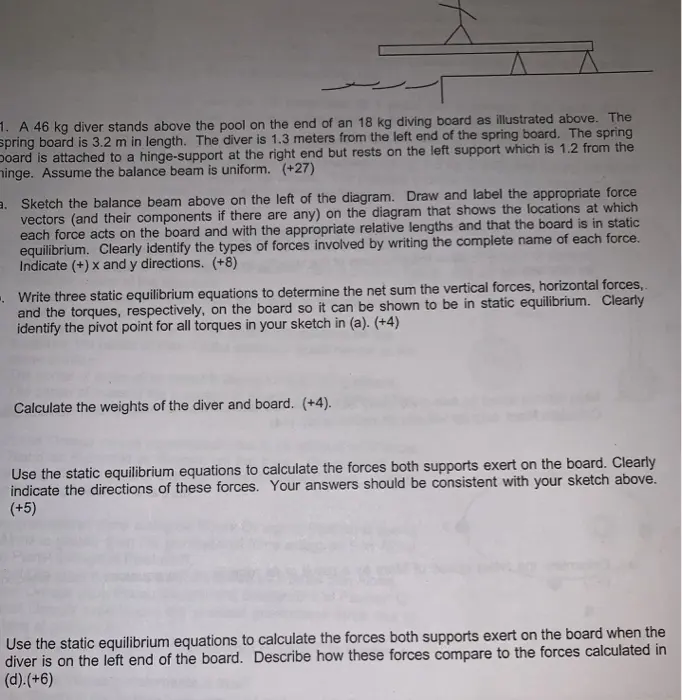
Transcribed Image Text:
1. A 46 kg diver stands above the pool on the end of an 18 kg diving board as illustrated above. The
Spring board is 3.2 m in length. The diver is 1.3 meters from the left end of the spring board. The spring
Doard is attached to a hinge-support at the right end but rests on the left support which is 1.2 from the
minge. Assume the balance beam is uniform. (+27)
a. Sketch the balance beam above on the left of the diagram. Draw and label the appropriate force
vectors (and their components if there are any) on the diagram that shows the locations at which
each force acts on the board and with the appropriate relative lengths and that the board is in static
equilibrium. Clearly identify the types of forces involved by writing the complete name of each force.
Indicate (+) x and y directions. (+8)
Write three static equilibrium equations to determine the net sum the vertical forces, horizontal forces,.
and the torques, respectively, on the board so it can be shown to be in static equilibrium. Clearly
identify the pivot point for all torques in your sketch in (a). (+4)
Calculate the weights of the diver and board. (+4).
Use the static equilibrium equations to calculate the forces both supports exert on the board. Clearly
indicate the directions of these forces. Your answers should be consistent with your sketch above.
(+5)
Use the static equilibrium equations to calculate the forces both supports exert on the board when the
diver is on the left end of the board. Describe how these forces compare to the forces calculated in
(d).(+6)
2. Mars orbits the Sun in one complete revolution every 687 days.
Assuming that Mars orbits the Sun in a circular orbit, use the appropriate
information found in your text to solve the following problems. (+20)
a.
Calculate the gravitational force that the Sun exerts on Mars. How.
does this force compare to the gravitational force Mars exerts on the
Sun? Explain. (+4)
b. Calculate the period (in seconds) for one complete revolution of Mars around the Sun. (+3)
c. Determine the magnitude and direction of the velocity (in m/s) and acceleration (in m/s2) of Mars
as it travels around the Sun. Include a sketch of the Sun and Mars (and it's orbit) along with
vectors to clearly to show the directions of the velocity and acceleration of Mars at one position in
its orbit around the Sun. (+6)
d. Mars rotates about its axis once every 24.6 hours counterclockwise as viewed from its North pole.
Calculate Mars' angular velocity (in rad/second). (+4)
e. Determine the linear speed of Mars as a result of its rotation at the equator (in meters/second).
(+3)
Fecalada
04/17/19
6
check_circle الجواب — حل مفصل خطوة بخطوة
hourglass_top
🔒
الحل الكامل متاح للمشتركين
اشترك في أرشيف الأسئلة لعرض هذا الحل وآلاف الحلول المفصلة خطوة بخطوة من معلمين معتمدين.