تم الحل ✓
categoryالفيزياء
schoolبكالوريوس
event_available2026-07-14
السؤال
Transcribed Image Text:
Interactive Exercises 28.06: Crossed Fields: The Hall Effect
d
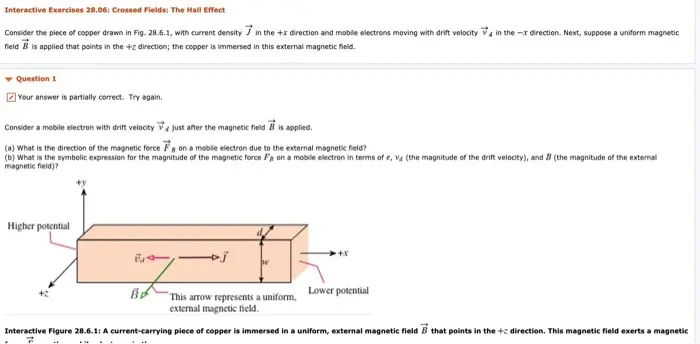
Consider the piece of copper drawn in Fig. 28.6.1, with current density in the +x direction and mobile electrons moving with drift velocity in the -x direction. Next, suppose a uniform magnetic
field B is applied that points in the +z direction; the copper is immersed in this external magnetic field.
Question 1
Your answer is partially correct. Try again.
Consider a mobile electron with drift velocity just after the magnetic field is applied.
(a) What is the direction of the magnetic force Fa on a mobile electron due to the external magnetic field?
(b) What is the symbolic expression for the magnitude of the magnetic force Fa on a mobile electron in terms of e, va (the magnitude of the drift velocity), and B (the magnitude of the external
magnetic field)?
Higher potential
W
+x
B
Lower potential
This arrow represents a uniform,
external magnetic field.
Interactive Figure 28.6.1: A current-carrying piece of copper is immersed in a uniform, external magnetic field that points in the + direction. This magnetic field exerts a magnetic
Interactive Figure 28.6.1: A current-carrying piece of copper is immersed in a uniform, external magnetic field B that points in the + direction. This magnetic field exerts a magnetic
force F on the mobile electrons in the copper.
(a) direction of Fy
(b) F
Edit
Click if you would like to Show Work for this question: Qoen Show Work
The charge distribution induced in the copper and represented in Fig. 28.6.2 (see the solution to Part 1) results in an electric field within the body of the conductor. Let's call this a transverse electric field
(a)
What is the direction of E,?
(b) What is the direction of the electric force Fg on a mobile electron due to the transverse electric field E,?
(c) What is the symbolic expression for the magnitude of the electric force Fg on a mobile electron due to the transverse electric field? The answer will be in terms of e and E, (the magnitude of the
transverse electric field).
(a) direction of E,
(b) direction of F+y
(c) Fg-
Edit
Consider the two points marked C and D in Fig. 28.6.3 (see the solution to Part 2). They are on opposite faces of the strip of copper. There is a potential difference AV, between C and D associated with
the transverse electric field E.
(a) Which point, C or D, has the higher value of electric potential?
(b) Assuming the transverse electric field is uniform within the copper, what is the magnitude of the transverse potential difference |AV,? This will be a symbolic answer in terms of E, (the magnitude of
the transverse electric field) and one of the dimensions of the strip of copper.
(a)
(b) |AV,
Edit
Click if you would like to Show Work for this question: Open Show Work
By accessing this Question Assistance, you will learn while you earn points based on the Point Potential Policy set by your instructor.
Attempts: Unlimited
SAVE FOR LATER SUBMIT ANSWER
Question 4
Assume the current density is uniform throughout the body of the copper. What is the current i in the copper? This will be a symbolic answer in terms of J (magnitude of current density), w (width of
copper), and d (thickness of copper).
check_circle الجواب — حل مفصل خطوة بخطوة
hourglass_top
🔒
الحل الكامل متاح للمشتركين
اشترك في أرشيف الأسئلة لعرض هذا الحل وآلاف الحلول المفصلة خطوة بخطوة من معلمين معتمدين.