تم الحل ✓
categoryالهندسة الكهربائية
schoolبكالوريوس
event_available2026-07-14
السؤال
Transcribed Image Text:
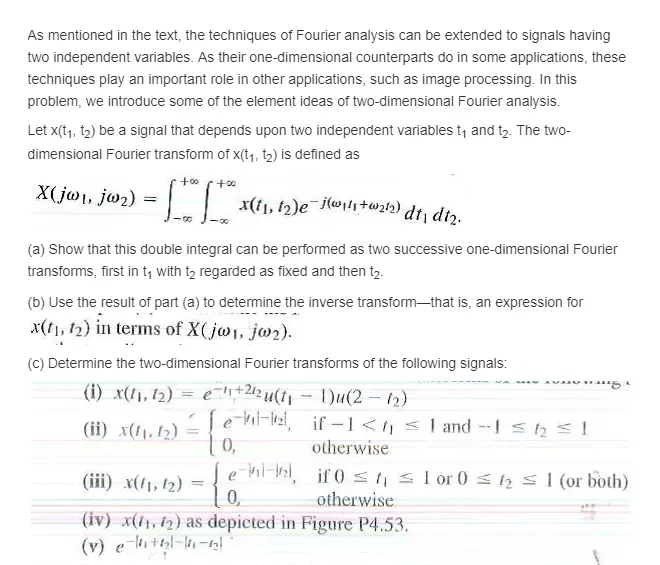
As mentioned in the text, the techniques of Fourier analysis can be extended to signals having
two independent variables. As their one-dimensional counterparts do in some applications, these
techniques play an important role in other applications, such as image processing. In this
problem, we introduce some of the element ideas of two-dimensional Fourier analysis.
Let x(t1, t2) be a signal that depends upon two independent variables t₁ and t₂. The two-
dimensional Fourier transform of x(t1, t2) is defined as
+00 +00
X (jo, j) =
x(11, 12) (+212) dt, diz.
12)(+212)
(a) Show that this double integral can be performed as two successive one-dimensional Fourier
transforms, first in t₁ with t₂ regarded as fixed and then t₂.
(b) Use the result of part (a) to determine the inverse transform—that is, an expression for
x(11, 12) in terms of X(jw1, jw2).
(c) Determine the two-dimensional Fourier transforms of the following signals:
(i) x(11, 12) = e−11+212 (11-1)u(2-12)
(ii) x(11, 12)=
(iii) x(11, 12)
======
e--if-1<<1 and -1 sh≤1
otherwise
0,
elif 0 ≤4 ≤ 1 or 0 ≤2 ≤ 1 (or both)
otherwise
0,
(iv) x(1, 2) as depicted in Figure P4.53.
(v) --
12
x(t1, t2) 1 in shaded area
and 0 outside
11
Figure P4.53
(d) Determine the signal x(t1, t2) whose two-dimensional Fourier transform
2TT
X(jw, jw)
=
8(w2 - 201).
4+ jwi
(e) Let x(1, 2) and h(t1, t2) be two signals with two-dimensional Fourie
forms X(jo, jw2) and H(jw, jw2), respectively. Determine the tran
of the following signals in terms of X(jo, jw2) and H(jw1, jw2):
(i) x(1T1, 12-T2)
(ii) x(at₁, bt₂)
+00
(iii) y(1,2) = + + x (11, 12)h (11 - 71, 12 - 12) dj d 12
+x(11, (11-1, 1212)
check_circle الجواب — حل مفصل خطوة بخطوة
hourglass_top
🔒
الحل الكامل متاح للمشتركين
اشترك في أرشيف الأسئلة لعرض هذا الحل وآلاف الحلول المفصلة خطوة بخطوة من معلمين معتمدين.