تم الحل ✓
categoryكيمياء
schoolبكالوريوس
event_available2026-07-14
السؤال
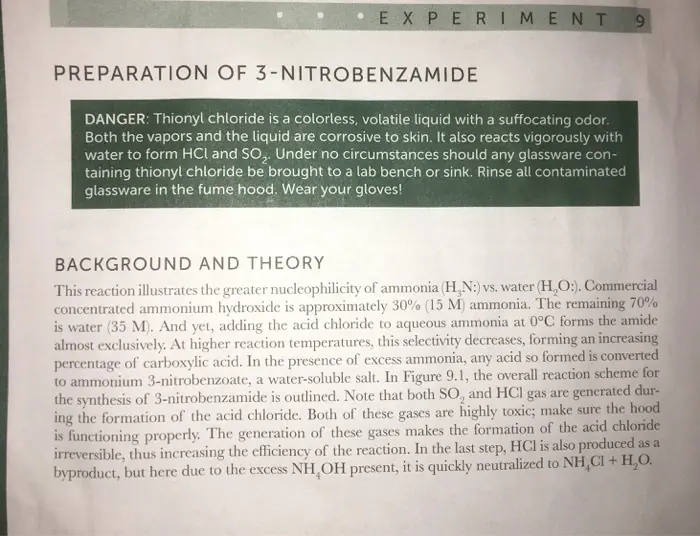
Transcribed Image Text:
EXPERIMENT 9
PREPARATION OF 3-NITROBENZAMIDE
DANGER: Thionyl chloride is a colorless, volatile liquid with a suffocating odor.
Both the vapors and the liquid are corrosive to skin. It also reacts vigorously with
water to form HCI and SO. Under no circumstances should any glassware con-
taining thionyl chloride be brought to a lab bench or sink. Rinse all contaminated
glassware in the fume hood. Wear your gloves!
BACKGROUND AND THEORY
This reaction illustrates the greater nucleophilicity of ammonia (H¸N:) vs. water (H,O:). Commercial
concentrated ammonium hydroxide is approximately 30% (15 M) ammonia. The remaining 70%
is water (35 M). And yet, adding the acid chloride to aqueous ammonia at 0°C forms the amide
almost exclusively. At higher reaction temperatures, this selectivity decreases, forming an increasing
percentage of carboxylic acid. In the presence of excess ammonia, any acid so formed is converted
to ammonium 3-nitrobenzoate, a water-soluble salt. In Figure 9.1, the overall reaction scheme for
the synthesis of 3-nitrobenzamide is outlined. Note that both SO, and HCl gas are generated dur-
ing the formation of the acid chloride. Both of these gases are highly toxic; make sure the hood
is functioning properly. The generation of these gases makes the formation of the acid chloride
irreversible, thus increasing the efficiency of the reaction. In the last step, HCl is also produced as a
byproduct, but here due to the excess NH,OH present, it is quickly neutralized to NH,Cl + H₂O.
Acids I-III: Carboxylic Acids
O₂N-
OH
SOCI₂
DMF
aqueous NH, O₂N-
Cl
དེགས་ ི་ ད་ལམ་ ་ ོ་ ིག་པ་
NH₂
+ SO2(g) + HCl(gas)
Figure 9.1. Preparation of an amide from a carboxylic acid.
The mechanism for the formation of the acid chloride (Figure 9.2) begins with the attack by the oxy-
gen of the hydroxyl group of the carboxylic acid (VI) on the sulfur of the thionyl chloride (SOCI).
This is quickly followed by the loss of a proton to yield intermediate VIII, a chlorosulfite, plus
HCI. Some of the HCl generated is lost as a gas and some reacts with dimethylformamide (DMF),
the co-solvent, which also acts as a weak base. Chloride anion then attacks the chlorosulfite at the
carbonyl carbon to yield intermediate IX. Loss of sulfur dioxide gas and chloride anion gives the
final product acid chloride. The formation of gaseous SO, and HCI both serve to drive the reaction
forward, as their escape makes the product formation irreversible.
O₂N
ork of
VI
H
VII
HCI (g) + SO2 (g) +
Extremely poisonous
gases
IX
ON-
A tetrahedral intermediate
Figure 9.2. Mechanism of acid chloride formation.
VIII
115
116
Experiments 7-9
Amide formation (Figure 9.3) begins with nucleophilic attack by ammonia on the carbonyl carbon
of the acid chloride followed by the ejection of the chloride anion to afford protonated amide X
This intermediate is then deprotonated by chloride anion, acting as a base, to yield the final product
amide XI.
O₂N
O₂N
NH3
:NH₂
IX
A tetrahedral intermediate
XI
ON
NH₂
x
NH₂
Figure 9.3. Mechanism of amide formation from an acid chloride
This exercise also illustrates the use of safety equipment. Thionyl chloride-containing solutions emit
noxious fumes. In addition, much dense white ammonium chloride smoke is formed when the reac-
tion mixture is added to the ammonia. The circulation of this visible smoke shows the movement
of all fumes within the hood. Note how the fumes move toward the front center of the hood. If you
work with the sash raised, the fumes, whether visible or invisible, blow directly at you. With the sash
lowered as much as possible, your face and body are protected from both fumes and unanticipated
splashes.
Both the original compound, 3-nitrobenzoic acid, and the final product, 3-nitrobenzamide, melt
close to 130°C when pure and dry. However, an intimate mixture of the two compounds melts quite
differently. This "mixed melting point" confirms that the two compounds are indeed different.
EXPERIMENTAL PROCEDURE
1. Place 0.5 g of well-powdered 3-nitrobenzoic acid and a stirring bar into a 10 ml. round bottom
flask. (The powdering is best done with a 25 ml. Erlenmeyer and smooth surfaced weighing
paper.)
2. Attach a drying tube containing a wad of cotton and a one-inch layer of calcium chloride.
3. Under a fume hood, clamp the assembly in a water bath, making sure the assembly is half
submerged in the water, and a thermoprobe is clamped in the water as well.
4. Remove the flask assembly and set it aside for the moment. Adjust the hot plate to warm the
water bath to 50°C.
5. Take the flask assembly to the chemical supply hood and temporarily remove the drying tube
assembly and add 0.4 mL. of thionyl chloride (d = 1.63 g/mL.) using the attached 1.0 ml. cali-
brated pipette. Then add 6 drops of dimethylformamide (DMF) to the flask and replace the
drying tube. Do this entire step in the chemical supply hood only, do not remove the thionyl
chloride bottle or its associated pipette from that hood.
Acids I-III: Carboxylic Acids
117
6. Bring the flask back to the hood with your 50°C water bath, clamp the assembly in place and
stir the mixture for 10 minutes at 50°C. It is essential to keep the temperature of the water bath
at 50° ± 5°C. Do not start tining if the temperature is below 45°C.
7. After the flask assembly is warming in the water bath place a 50 ml. Erlenmeyer flask contain-
ing 12 ml of concentrated ammonia (15 M) in an ice bath in the same hood, close to your
water bath.
Note: In research labs, often such water-sensitive reactions are performed under
an inert atmosphere (argon or nitrogen gas) rather than using a drying tube.
8. If the entire sample has not liquified after approximately 10 minutes, remove the flask assembly
from the water bath, take it to the chemical supply hood and add another 0.2 mL. of thionyl
chloride to the mixture, as before.
9. Bring the flask assembly back to your water bath and continue heating until no solid remains.
Continuous stirring also helps to complete the reaction.
10. Once the reaction is complete, raise the reaction flask above the water bath and remove the
drying tube. Use an eyedropper to transfer the acid chloride solution dropwise (slowly, at a rate
of I drop per two seconds) to the ice-cold flask of ammonia while stirring. Keep the ammonia
solution in the ice bath during the addition of 3-nitrobenzoyl chloride.
REMEMBER TO KEEP YOUR HEAD OUT OF THE EXHAUST HOODS AT ALL TIMES
DURING THIS EXPERIMENT. BOTH HCI AND SO, ARE EXTREMELY POISONOUS
GASES.
11. Maximum yields are obtained when the addition is performed with cold ammonia, which is
stirred continuously. Keeping 1-2 pieces of ice in the ammonia solution during the addition
will help keep the temperature close to 0°C. Inverting the eyedropper allows the acyl chloride
to enter the rubber bulb, contaminating your product and destroying the rubber. Do not hold
an eyedropper upside down.
12. When the addition is complete, rinse the round bottom flask and the eyedropper with some
ammonia. The materials may now be safely removed from the hood if the ammonia flask is
stoppered. Otherwise, cool it in the hood.
13. Cool the crude amide for a few minutes, and collect the solid by suction filtration on a Hirsch
funnel. A 1.5 cm piece of filter paper should just cover the bottom of the funnel, the same as a
Büchner funnel.
14. Wash the product well with water to remove a large amount of NH,CI. Pour this ammonia
waste down the drain promptly, and rinse with water.
15. Use a 10 ml. pear-shaped flask to recrystallize the crude amide by dissolving it in a mini-
mum amount of denatured ethanol with heating (1-2 mL depending on the yield of your
3-nitrobenzamide).
16. Then add enough water to just saturate (first cloudiness) the solution followed by addition of
1-2 drops of ethanol. Do not add more than 5 mL. of water in any case, as the product is also
somewhat soluble in water.
3
Experiments 7-9
17. The above crystallization is a difficult one to perform successfully. It is always a good idea to
keep a few crystals of the crude product for "seeding" in case you have trouble with the recrys-
tallization. Remember, also, that a trace of ammonium chloride may be trapped in the crude
amide it will be virtually insoluble in denatured ethanol so you may have to filter it.
18. Use your Hirsch funnel to collect the product by suction filtration after cooling the 10 mL.
pear-shaped flask in an ice bath for five minutes. The mother liquor should be added to the
Hazardous Waste Container.
19. If you have not already done so, return the calcium chloride to the solid waste container.
Calcium chloride left in drying tubes will eventually form a solid cake that is almost impossible
to remove.
20. Simultaneously determine the melting point of the starting 3-nitrobenzoic acid, the final amide,
and an intimately ground mixture of the two solids. The amide and corresponding acid both
melt near 130°C. The range is from the first appearance of liquid until the complete disappear-
ance of solid. It should be quite wide for a mixed melting point.
REPORT
Calculate the percent yield for all three reactions. Show your work in detail.
Submit all products in properly labeled vials for full credit.
The glassware for next week's experiment must be completely dry. Clean the fol-
lowing equipment and place them in a labeled 250 mL beaker with your name and
section number written on it. Allow them to dry thoroughly in an oven for at least 30
minutes. Make sure to take the hot glassware out of the oven and place them in
drawer before exiting from the lab; you may risk losing them forever. The estimated
replacement cost is approximately $100.
8 mL vial, 5 mL vial, Claisen adapter, air condenser, drying tube, glass stirring rod, and triangular stir bar
DO NOT PLACE O-RINGS OR PLASTIC CAPS IN THE OVENS; THEY WILL MELT!
your
check_circle الجواب — حل مفصل خطوة بخطوة
hourglass_top
🔒
الحل الكامل متاح للمشتركين
اشترك في أرشيف الأسئلة لعرض هذا الحل وآلاف الحلول المفصلة خطوة بخطوة من معلمين معتمدين.