تم الحل ✓
categoryطب وبائيات وصحة عامة
schoolبكالوريوس
event_available2026-07-14
السؤال
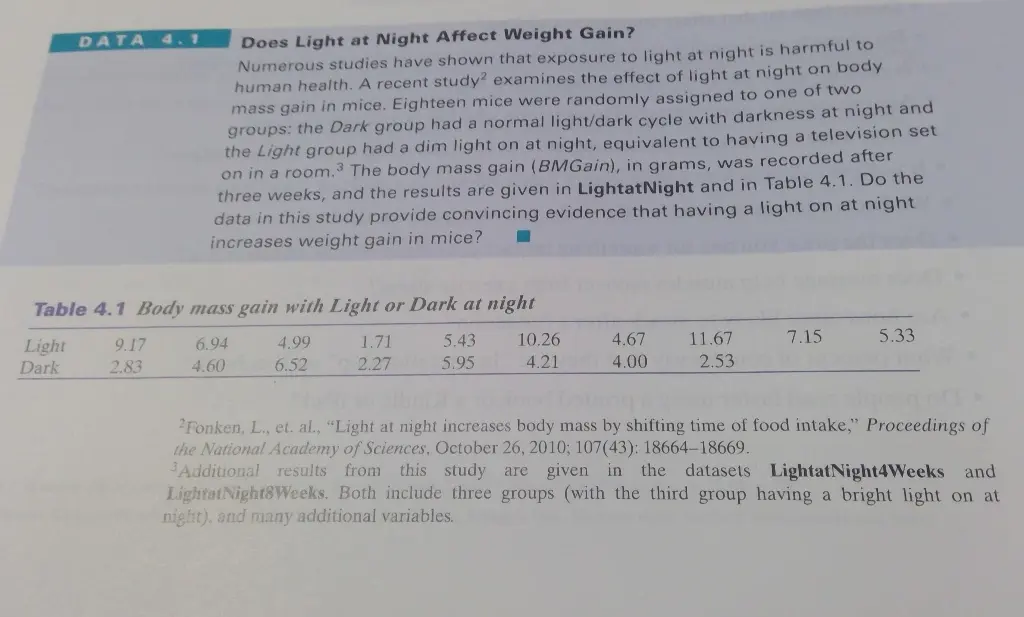
Transcribed Image Text:
DATA 4.1
Does Light at Night Affect Weight Gain?
Numerous studies have shown that exposure to light at night is harmful to
human health. A recent study2 examines the effect of light at night on body
mass gain in mice. Eighteen mice were randomly assigned to one of two
groups: the Dark group had a normal light/dark cycle with darkness at night and
the Light group had a dim light on at night, equivalent to having a television set
on in a room. The body mass gain (BMGain), in grams, was recorded after
three weeks, and the results are given in LightatNight and in Table 4.1. Do the
data in this study provide convincing evidence that having a light on at night
increases weight gain in mice?
3
Table 4.1 Body mass gain with Light or Dark at night
Light
Dark
9.17
2.83
6.94
4.99
1.71
4.60
6.52
2.27
5.43
5.95
10.26
4.67
11.67
7.15
5.33
4.214.00
2.53
2Fonken, L., et. al., "Light at night increases body mass by shifting time of food intake," Proceedings of
the National Academy of Sciences, October 26, 2010; 107(43): 18664-18669.
3Additional results from this study are given in the datasets LightatNight4Weeks and
LightatNight8Weeks. Both include three groups (with the third group having a bright light on at
night), and many additional variables.
In Data 4.1 on page 258, we examine a study in which mice were randomly assigned to either a normal
light/dark cycle or to have a light on around the clock. According to the paper describing that study,
"The global increase in the prevalence of obesity and metabolic disorders coincides with the increase of
exposure to light at night." The study is examining whether light at night plays a causal role in the
obesity epidemic. In Data 4.1, we examine the effectof hte different light conditions on body mass gain
after three weeks. In fact, the actual experiment lasted 8 weeks and examined many additional
variables. The data referenced here are available in LightatNight8weeks. Some of the variables are
summarized in the following table.
Variable Name
Condition
BMGain
Corticosterone
DayPct
Consumption
Glocoselnt
Activity
Variable Description
Treatment group (Light or Dark)
Change in body mass (in grams) after 8 weeks
Blood corticosterone level (a measure of stress)
Percentage of calories consumed during the day
Average daily food consumption (in grams)
Glucose intolerant at end of study? (Yes or No)
A measure of physical activity level
1. What are the cases? What is the explanatory variable? Is this a randomized experiment or an
observational study?
2. What is the mean body mass gain for all the mice in this dataset? What is the five number
summary? Show a graph of the body mass gains in the sample. Do there appear to be any
outliers? Find and interpret a 95% confidence interval for mean body mass gain.
3. The primary question in the study was whether having a light on at night causes greater average
body mass gain. Give side-by-side boxplots comparing body mass gain for the two groups. Does
having a light on at night appear to increase body mass gain in mice?
4. Conduct a hypothesis test to see if the data provide evidence that mean body mass gain is
higher for mice with a light on at night. Show all details of the test. If the results are significant,
can we conclude that there is a causal association? Why or why not?
5. To examine how large is the effect on body mass gain of having a light on at night, give a 99%
confidence interval for the difference in mean body mass gain between mice with a light on at
night and mice with darkness at night. Interpret the interval in context.
6. Perhaps the difference in weight gain between the two groups was affected by a difference in
food consumption. Conduct a hypothesis test for a difference in mean consumption between the
two groups. Is there evidence of a significant difference in average food consumption between
the two groups?
7. Perhaps the difference in weight gain between the two groups was affected by a difference in
activity level. Conduct a hypothesis test for a difference in mean activity level between the two
groups. Is there evidence of a significant difference in average activity level between the two
groups?
8. Perhaps the difference in weight gain between the two groups was affected by a difference in the
time of day in which the mice at their food. Conduct a hypothesis test for a difference in mean
percentage of calories consumed during the day between the two groups. Is there evidence of a
significant difference in mean percentage between the two groups? (Mice in the wild eat almost
all of their calories during the dark nighttime hours, so a high percentage eaten during the day is
unusual for mice.)
9. Summarize the results of the tests in parts (6), (7), and (8). For any that show a significant effect,
conduct a test to determine if there is a significant correlation between that quantitative variable
and body mass gain. Is the correlation positive or negative, and what does that mean in this
context?
10. The study examined other effects of light at night in addition to body mass gain. Conduct a test to
see if the proportion of mice who become glucose intolerant is higher for mice with a light on than
for mice in darkness. Note that in StatKey all you need is the relevant counts and sample sizes
(not the full dataset) to run this test.
11. Higher blood corticosterone levels indicate greater physiological levels of stress. Find and
interpret a 90% confidence interval for the difference in mean corticosterone levels between mice
with a light on and mice in darkness. Does the confidence interval allow us to conclude that there
is a difference in mean corticosterone levels between the two groups? If so, which group has
higher mean levels?
12. Write a paragraph summaring the results of your findings. If the results of the study can be
generalized to humans, what are the take-away messages?
check_circle الجواب — حل مفصل خطوة بخطوة
hourglass_top
🔒
الحل الكامل متاح للمشتركين
اشترك في أرشيف الأسئلة لعرض هذا الحل وآلاف الحلول المفصلة خطوة بخطوة من معلمين معتمدين.