تم الحل ✓
categoryهندسة ميكانيكية
schoolبكالوريوس
event_available2026-07-14
السؤال
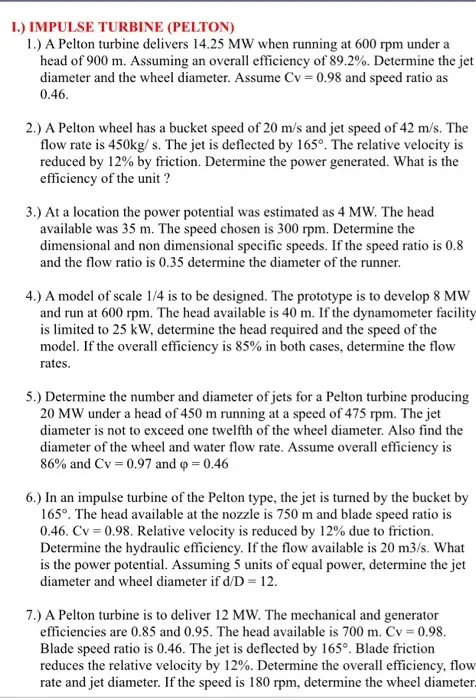
Transcribed Image Text:
I.) IMPULSE TURBINE (PELTON)
1.) A Pelton turbine delivers 14.25 MW when running at 600 rpm under a
head of 900 m. Assuming an overall efficiency of 89.2%. Determine the jet
diameter and the wheel diameter. Assume Cv = 0.98 and speed ratio as
0.46.
2.) A Pelton wheel has a bucket speed of 20 m/s and jet speed of 42 m/s. The
flow rate is 450kg/s. The jet is deflected by 165°. The relative velocity is
reduced by 12% by friction. Determine the power generated. What is the
efficiency of the unit?
3.) At a location the power potential was estimated as 4 MW. The head
available was 35 m. The speed chosen is 300 rpm. Determine the
dimensional and non dimensional specific speeds. If the speed ratio is 0.8
and the flow ratio is 0.35 determine the diameter of the runner.
4.) A model of scale 1/4 is to be designed. The prototype is to develop 8 MW
and run at 600 rpm. The head available is 40 m. If the dynamometer facility
is limited to 25 kW, determine the head required and the speed of the
model. If the overall efficiency is 85% in both cases, determine the flow
rates.
5.) Determine the number and diameter of jets for a Pelton turbine producing
20 MW under a head of 450 m running at a speed of 475 rpm. The jet
diameter is not to exceed one twelfth of the wheel diameter. Also find the
diameter of the wheel and water flow rate. Assume overall efficiency is
86% and Cv = 0.97 and p = 0.46
6.) In an impulse turbine of the Pelton type, the jet is turned by the bucket by
165°. The head available at the nozzle is 750 m and blade speed ratio is
0.46. Cv=0.98. Relative velocity is reduced by 12% due to friction.
Determine the hydraulic efficiency. If the flow available is 20 m3/s. What
is the power potential. Assuming 5 units of equal power, determine the jet
diameter and wheel diameter if d/D = 12.
7.) A Pelton turbine is to deliver 12 MW. The mechanical and generator
efficiencies are 0.85 and 0.95. The head available is 700 m. Cv = 0.98.
Blade speed ratio is 0.46. The jet is deflected by 165°. Blade friction
reduces the relative velocity by 12%. Determine the overall efficiency, flow
rate and jet diameter. If the speed is 180 rpm, determine the wheel diameter.
II.) REACTION TURBINE (GENERAL)
8.) An inward flow reaction turbine develops 185 kW under a head of 30 m.
Guide vane outlet angle is 20°. Vane outlet angle is 25° and outlet is radial.
The ratio of inlet to outlet area is 3: 4. Loss in guide vane is 10% of
velocity head at inlet. Loss in the runner is 20% of outlet radial velocity
head. Determine the pressure at inlet of the wheel, flow rate, and area at
outlet of the guide vanes.
9.) An inward flow reaction turbine works under a head of 25 m. The
hydraulic efficiency is 80%. The turbine speed is 300 rpm. The peripheral
velocity is 30 m/s. The flow velocity is 4 m/s. Determine the guide blade
outlet angle, the runner inlet angle and the runner diameter.
III.) REACTION TURBINE (FRANCIS)
10.) A Francis turbine works under a head of 14 m. The guide vane outlet
angle is 20° and the blade angle at inlet is 90°. The ratio of diameters is 3:
2. The flow velocity is constant at 4m/s. Determine the peripheral velocity
of the runner. Assume zero whirl at exit.
11.) In a Francis turbine the guidevane outlet angle is 10°. The inlet blade
angle is 90°. The runner diameters are 1 m and 0.5 m. Whirl at exit is zero.
The flow velocity is 3 m/s both at inlet and outlet. Determine the speed of
the wheel and the outlet angle of the runner.
12.) A Franics turbine runs at 268 rpm. The outer diameter is 1.2 m. The blade
angle at inlet is 90°. If the flow rate is 1 kg/s, determine the power
developed. If the head is 30 m determine the hydraulic efficiency. If the
guide blade outlet angle is 15° and if the flow velocity is constant,
determine the runner outlet angle. Whirl at exit is zero.
13.) A Franics turbine for a power plant is to be designed for a power of 30
MW. The head available is 190 m. The speed is to be 180 rpm. A model for
the unit is to be designed. The power available in the laboratory is 40 kW.
A one sixth scale model is to be adopted. Determine the speed, head and
flow rate for the model. Assume an overall efficiency of 98%.
14.) A Kaplan turbine delivers with an overall efficiency of 90%. 25 MW, the
head available being 40 m. The speed ratio and flow ratio are 2 and 0.6
respectively. The hub to tip ratio is 0.4. Determine the diameter and speed
of the turbine.
15.) An axial flow turbine has a tip diameter of 4.5 m and hub diameter of 2.5
m. The power developed is 21 MW. The running speed is 140 rpm. The net
head is 20 m. The hydraulic and overall efficiencies are 94% and 80%
respectively. Calculate the guide vane outlet angle and the blade inlet angle.
16.) A Kaplan turbine operates under a net head of 20 m and develops 16 MW
with a hydraulic efficiency of 90 percent and overall efficiency of 80
percent. The runner outer diameter is 4.2 m. The hub diameter is 2 m. The
dimensionless specific speed is 0.8. Determine the blade inlet and outlet
angles at the tip if Vu2 = 0.
17.) In a draft tube fixed to a reaction turbine the inlet diameter is 3 m and the
outlet area is 20 m2. The velocity at inlet is 5 m/s. The turbine exit is 5 m
above the tail race level. The loss in the draft tube is 50% of the velocity
head at outlet, Determine the pressure at the top of the draft tube. Also find
the head lost in the draft tube.
V.) PUMP (GENERAL/RECIPROCATING)
18.) A single acting pump running at 30 rpm delivers 6.5 l/s of water. The
bore and stroke are 20 cm and 30 cm respectively. Determine the
percentage slip and coefficient of discharge.
19.) A single acting pump has a bore and stroke of 300 mm and 400 mm
respectively. The discharge is 50 l/s. If the slip is 2%, determine the speed
of operation.
20.) The bore and stroke of a single acting reciprocating pump are 300 mm
and 450 mm respectively. The static suction head is 4 m. The suction pipe
is 125 mm in diameter and 8 m long. If the separation head is 2.5 m
determine the maximum speed of operation of the pump. Atmospheric head
is 10.3 m of water. Also calculate the discharge at this speed and the
maximum friction head on the suction side. f=0.02. What will be pressure
at starting, middle and end of stroke?
20.) The bore and stroke of a single acting reciprocating pump are 300 mm
and 450 mm respectively. The static suction head is 4 m. The suction pipe
is 125 mm in diameter and 8 m long. If the separation head is 2.5 m
determine the maximum speed of operation of the pump. Atmospheric head
is 10.3 m of water. Also calculate the discharge at this speed and the
maximum friction head on the suction side. f=0.02. What will be pressure
at starting, middle and end of stroke?
21.) A single acting reciprocating pump running at 24 rpm has a bore and
stroke of 12.5 cm and 30 cm. The static suction 4 m. Determine the
pressure at start, middle and end of suction stroke. The suction pipe of 75
mm diameter is 9 m long. Atmospheric pressure is 10.3 m of water
22.) A reciprocating pump running at 60 rpm has a bore of 300 mm and stroke
of 450 mm. The delivery pipe of 150 mm diameter is 50 m long. Determine
the saving in friction power due to fitting of an air vessel on the delivery
side. f = 0.02.
23.) The bore and stroke of a reciprocating pump are 25 cm and 50 cm. The
delivery pipe is of 100 mm diameter. The delivery is to a tank 15 m above
the pump. Determine the speed if separation should not occur. The
separation pressure is 2.3 m. The tank is at a distance of 30 m horizontally
from the pump. There is no air vessel. Case (i) Pipe is vertical up to 15 m
and then horizontal. Case (ii) Pipe is horizental for 30 m and then vertical.
24.) Determine the change in the maximum speed of operation due to fitting
an air vessel on the suction side of a pump of 300 mm bore and 500 mm
stroke. The suction pipe of 200 mm diameter is 10 m long. The suction lift
is 3.5 m.
25.) A double acting pump of 175 mm bore and 350 mm stroke runs at 150
rpm. The suction pipe is of 150 mm diameter. Determine the crank angle at
which there will be no flow from or to the air vessel.
check_circle الجواب — حل مفصل خطوة بخطوة
hourglass_top
🔒
الحل الكامل متاح للمشتركين
اشترك في أرشيف الأسئلة لعرض هذا الحل وآلاف الحلول المفصلة خطوة بخطوة من معلمين معتمدين.