تم الحل ✓
categoryهندسة مدنية
schoolبكالوريوس
event_available2026-07-14
السؤال
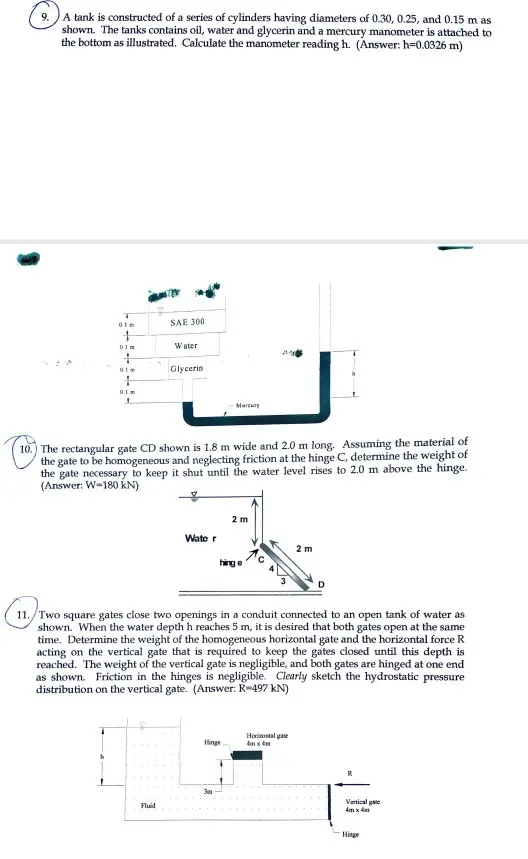
Transcribed Image Text:
A tank is constructed of a series of cylinders having diameters of 0.30, 0.25, and 0.15 m as
shown. The tanks contains oil, water and glycerin and a mercury manometer is attached to
the bottom as illustrated. Calculate the manometer reading h. (Answer: h=0.0326 m)
0.1 m
SAE 300
0.1 m
+
0.1 m
Water
Glycerin
Mercury
10. The rectangular gate CD shown is 1.8 m wide and 2.0 m long. Assuming the material of
the gate to be homogeneous and neglecting friction at the hinge C, determine the weight of
the gate necessary to keep it shut until the water level rises to 2.0 m above the hinge.
(Answer: W-180 kN)
2 m
Water
2 m
hinge
11. Two square gates close two openings in a conduit connected to an open tank of water as
shown. When the water depth h reaches 5 m, it is desired that both gates open at the same
time. Determine the weight of the homogeneous horizontal gate and the horizontal force R
acting on the vertical gate that is required to keep the gates closed until this depth is
reached. The weight of the vertical gate is negligible, and both gates are hinged at one end
as shown. Friction in the hinges is negligible. Clearly sketch the hydrostatic pressure
distribution on the vertical gate. (Answer: R-497 kN)
Fluid
Horizontal gate
Hinge
4m x 4m
3
R
Vertical gate
4m x 4m
Hinge
17. Water flows steadily through the large tanks shown where h-2 m. The diameters of the
pipes exiting tanks A and B are 0.03 m and 0.05 m, respectively. Neglecting frictional
losses, determine the water depth ha. (Answer: hA-15.4 m)
18. Water flows from a large tank through a large pipe that splits into two smaller pipes as
shown. If viscous effects are negligible, determine the flowrate from the tank and the
pressure at point (1). Determine the net horizontal force that the pipe and tank exert on the
fluid. (Answer: p-57851 PaG)
3m
7m
0.03 m diameter
4m
0.02mdiameter
0.05mdiameter
3m
19. A hydroelectric power plant operates under the conditions illustrated. The frictional losses
associated with the flow from the water upstream of the dam, section (1), to the turbine
discharge at atmospheric pressure, section (2), is 196 J/kg. How much power is
transferred from the water to the turbine blades? (Answer: P-23.5 MW)
Section (1)
Q-30 m
100m
Turbine
Section (2)
0. Air flows into the atmosphere from a nozzle and strikes a vertical plate as shown. A
horizontal force of 12 N is required to hold the plate in place. Determine the reading on
the pressure gage if the pipe's cross-sectional area is 0.01 m² and the free jet's cross-
sectional area is 0.003 m².
Assume the flow to be incompressible and frictionless.
(Answer: 1.82 kPaG)
12 N
21. Two water jets of equal size and speed strike each other as shown. The diameter of these
jets is 0.0348 m. Determine the speed v in m/s and direction 0 of the resulting combined
jet to the horizontal, where is the angle measured from the horizontal. Gravity is
negligible. Convert all units to standard SI before solving. Note that 1 ft-0.3048 m.
(Answer: v=2.155 m/s)
v,-10 / st
90°
v₂-10/T
22. Assuming frictionless, incompressible, one-dimensional flow of water through the
horizontal tee connection sketched below, estimate values of the x and y components of the
force exerted by the tee on the water. The flowrate in Section 3 is 10 m³/s. The velocity
and pressure in Section 1 are 6 m/s and 200 kPaG, respectively. Each pipe has an inside
diameter of 1 m. (Answer: R,-185 kN)
Section (3)-
-Section (2)
Section (1)
24. Oil (SG-0.9) flows downward through a vertical pipe contraction as shown. If the mercury
manometer reading h is 100 mm, determine the volumetric flowrate for frictionless flow.
Is the actual flowrate more or less than the frictionless value? Explain. (Answer: Q=0.042
m³/s)
-300 mm
100 mm
25. Water is pumped from the tank shown. The frictional head loss is 1.2v2/2g, where v is the
average velocity in the pipe. The vertical distance between the free surface and centerline
of the pipe is 6 m, and the pipe's diameter is 7 cm. According to the pump manufacturer,
the relationship between the pump head and the flowrate is as shown, where hp is in
meters and Q is in m³/s. Determine the flowrate Q. (Answer: Q=0.052 m³/s)
20
Pump
10
h, 20-200002
0.05
Q. m³/s
0.1
check_circle الجواب — حل مفصل خطوة بخطوة
hourglass_top
🔒
الحل الكامل متاح للمشتركين
اشترك في أرشيف الأسئلة لعرض هذا الحل وآلاف الحلول المفصلة خطوة بخطوة من معلمين معتمدين.