تم الحل ✓
categoryهندسة بحرية وملاحة
schoolبكالوريوس
event_available2026-07-14
السؤال
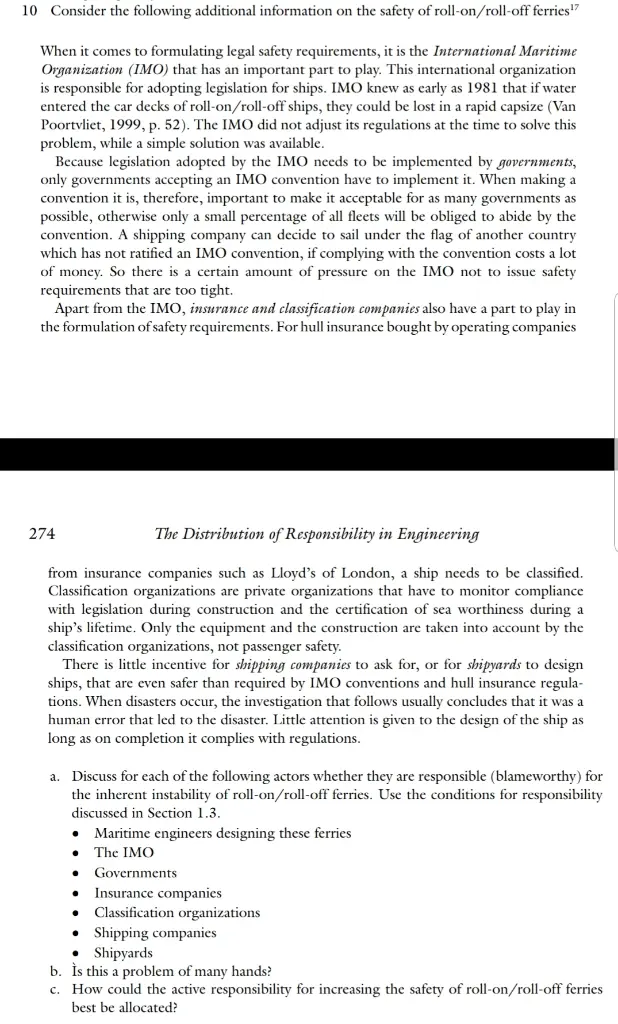
Transcribed Image Text:
10 Consider the following additional information on the safety of roll-on/roll-off ferries¹>
When it comes to formulating legal safety requirements, it is the International Maritime
Organization (IMO) that has an important part to play. This international organization
is responsible for adopting legislation for ships. IMO knew as early as 1981 that if water
entered the car decks of roll-on/roll-off ships, they could be lost in a rapid capsize (Van
Poortvliet, 1999, p. 52). The IMO did not adjust its regulations at the time to solve this
problem, while a simple solution was available.
Because legislation adopted by the IMO needs to be implemented by governments,
only governments accepting an IMO convention have to implement it. When making a
convention it is, therefore, important to make it acceptable for as many governments as
possible, otherwise only a small percentage of all fleets will be obliged to abide by the
convention. A shipping company can decide to sail under the flag of another country
which has not ratified an IMO convention, if complying with the convention costs a lot
of money. So there is a certain amount of pressure on the IMO not to issue safety
requirements that are too tight.
Apart from the IMO, insurance and classification companies also have a part to play in
the formulation of safety requirements. For hull insurance bought by operating companies
274
The Distribution of Responsibility in Engineering
from insurance companies such as Lloyd's of London, a ship needs to be classified.
Classification organizations are private organizations that have to monitor compliance
with legislation during construction and the certification of sea worthiness during a
ship's lifetime. Only the equipment and the construction are taken into account by the
classification organizations, not passenger safety.
There is little incentive for shipping companies to ask for, or for shipyards to design
ships, that are even safer than required by IMO conventions and hull insurance regula-
tions. When disasters occur, the investigation that follows usually concludes that it was a
human error that led to the disaster. Little attention is given to the design of the ship as
long as on completion it complies with regulations.
a. Discuss for each of the following actors whether they are responsible (blameworthy) for
the inherent instability of roll-on/roll-off ferries. Use the conditions for responsibility
discussed in Section 1.3.
⚫ Maritime engineers designing these ferries
⚫
The IMO
⚫
Governments
Insurance companies
Classification organizations
Shipping companies
Shipyards
b. Is this a problem of many hands?
c. How could the active responsibility for increasing the safety of roll-on/roll-off ferries
best be allocated?
check_circle الجواب — حل مفصل خطوة بخطوة
hourglass_top
🔒
الحل الكامل متاح للمشتركين
اشترك في أرشيف الأسئلة لعرض هذا الحل وآلاف الحلول المفصلة خطوة بخطوة من معلمين معتمدين.