تم الحل ✓
categoryاقتصاد عام
schoolبكالوريوس
event_available2026-07-13
السؤال
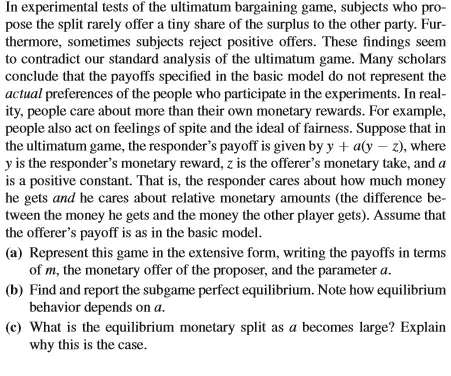
Transcribed Image Text:
In experimental tests of the ultimatum bargaining game, subjects who pro-
pose the split rarely offer a tiny share of the surplus to the other party. Fur-
thermore, sometimes subjects reject positive offers. These findings seem
to contradict our standard analysis of the ultimatum game. Many scholars
conclude that the payoffs specified in the basic model do not represent the
actual preferences of the people who participate in the experiments. In real-
ity, people care about more than their own monetary rewards. For example,
people also act on feelings of spite and the ideal of fairness. Suppose that in
the ultimatum game, the responder's payoff is given by y + a(y - z), where
y is the responder's monetary reward, z is the offerer's monetary take, and a
is a positive constant. That is, the responder cares about how much money
he gets and he cares about relative monetary amounts (the difference be-
tween the money he gets and the money the other player gets). Assume that
the offerer's payoff is as in the basic model.
(a) Represent this game in the extensive form, writing the payoffs in terms
of m, the monetary offer of the proposer, and the parameter a.
(b) Find and report the subgame perfect equilibrium. Note how equilibrium
behavior depends on a.
(c) What is the equilibrium monetary split as a becomes large? Explain
why this is the case.
check_circle الجواب — حل مفصل خطوة بخطوة
hourglass_top
🔒
الحل الكامل متاح للمشتركين
اشترك في أرشيف الأسئلة لعرض هذا الحل وآلاف الحلول المفصلة خطوة بخطوة من معلمين معتمدين.