تم الحل ✓
categoryهندسة مدنية
schoolبكالوريوس
event_available2026-07-14
السؤال
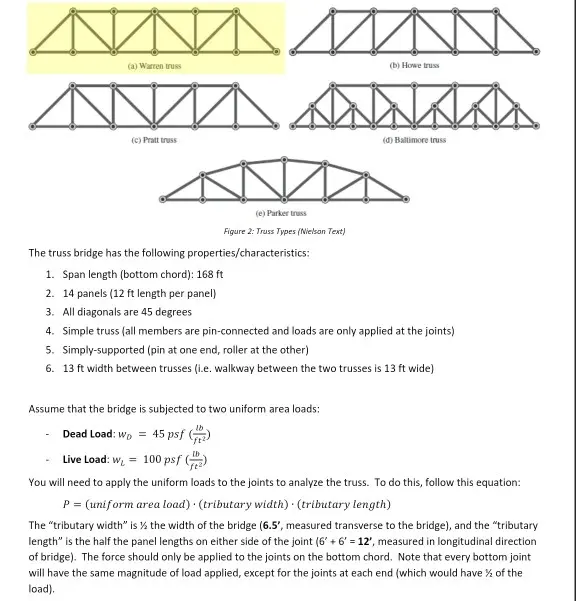
Transcribed Image Text:
(a) Warren truss
MN
(b) Howe truss
(c) Pratt truss
(e) Parker truss
(d) Baltimore truss
Figure 2: Truss Types (Nielson Text)
The truss bridge has the following properties/characteristics:
1. Span length (bottom chord): 168 ft.
2. 14 panels (12 ft length per panel)
3. All diagonals are 45 degrees
4. Simple truss (all members are pin-connected and loads are only applied at the joints)
5. Simply-supported (pin at one end, roller at the other)
6. 13 ft width between trusses (i.e. walkway between the two trusses is 13 ft wide)
Assume that the bridge is subjected to two uniform area loads:
Dead Load: Wp 45 psf ()
Live Load: w₁ = 100 psf ()
You will need to apply the uniform loads to the joints to analyze the truss. To do this, follow this equation:
P = (uniform area load) (tributary width). (tributary length)
The "tributary width" is % the width of the bridge (6.5', measured transverse to the bridge), and the "tributary
length" is the half the panel lengths on either side of the joint (6' + 6' = 12', measured in longitudinal direction
of bridge). The force should only be applied to the joints on the bottom chord. Note that every bottom joint
will have the same magnitude of load applied, except for the joints at each end (which would have % of the
load).
Note: you only need to analyze one of the two trusses that make up this bridge (i.e. it is a single 2D truss
problem). Do not consider any other loads (e.g. self weight, wind, etc.) that are not described above.
Tasks to complete:
A) Dead Load: considering only the provided dead load
a. Determine the maximum compressive force in a chord (horizontal) member. This will occur at
the top chord member(s) closest to the midspan of the truss.
b. Determine the maximum tensile force in a chord (horizontal) member. This will occur at the
bottom chord member(s) closest to the midspan of the truss.
c. Determine the maximum force (tensile or compressive) in a diagonal member, and indicate
type of force (axial/compressive) and location. This maximum force will occur in the diagonal
member(s) closest to a support.
B) Live Load: considering only the provided live load
a. Determine the maximum compressive force in a chord (horizontal) member. This will occur at
the top chord member(s) closest to the midspan of the truss.
b. Determine the maximum tensile force in a chord (horizontal) member. This will occur at the
bottom chord member(s) closest to the midspan of the truss.
c. Determine the maximum force (tensile or compressive) in a diagonal member, and indicate
type of force (axial/compressive) and location. This maximum force will occur in the diagonal
member(s) closest to a support.
C) Maximum Load: assume that Trimet inspectors recently discovered a "fatigue" crack in one of the
bottom chord members. Fatigue cracking is caused by repetitive tensile loading/unloading of a
member. Based on the inspection report, Trimet estimates that to be safe, the tensile force in a chord
should be limited to 100 kips. Determine the maximum uniform load (in psf) that can be applied to the
truss before a chord member reaches 100 kips of tension.
HINTS/NOTES:
1. You should leave the loading in variable format so that your calculations can apply to multiple
subparts. For example, if you leave the uniform load (w) as a variable, then solve for the max forces in
the top chord, bottom chord, and diagonal, you will have the force for each member in terms of w.
That way, your work will be usable for parts A), B), and C)!
2. Use the method of sections to determine the forces in the top and bottom chords near midspan.
3. Use the method of joints to determine the max force in the diagonal near the support.
check_circle الجواب — حل مفصل خطوة بخطوة
hourglass_top
🔒
الحل الكامل متاح للمشتركين
اشترك في أرشيف الأسئلة لعرض هذا الحل وآلاف الحلول المفصلة خطوة بخطوة من معلمين معتمدين.