تم الحل ✓
categoryهندسة الطيران والفضاء
schoolبكالوريوس
event_available2026-07-14
السؤال
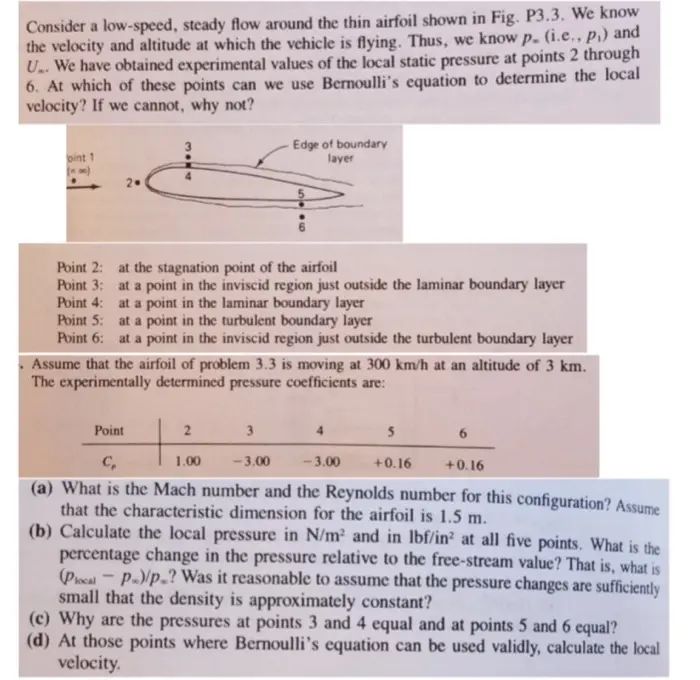
Transcribed Image Text:
Consider a low-speed, steady flow around the thin airfoil shown in Fig. P3.3. We know
the velocity and altitude at which the vehicle is flying. Thus, we know p. (i.e., p.) and
U.. We have obtained experimental values of the local static pressure at points 2 through
6. At which of these points can we use Bernoulli's equation to determine the local
velocity? If we cannot, why not?
bint 1
3034
Edge of boundary
layer
5
Point 2: at the stagnation point of the airfoil
at a point in the inviscid region just outside the laminar boundary layer
at a point in the laminar boundary layer
Point 3:
Point 4:
Point 5:
at a point in the turbulent boundary layer
Point 6: at a point in the inviscid region just outside the turbulent boundary layer
Assume that the airfoil of problem 3.3 is moving at 300 km/h at an altitude of 3 km.
The experimentally determined pressure coefficients are:
Point
2
3
C,
1.00
-3.00
-3.00
5
6
+0.16
+0.16
(a) What is the Mach number and the Reynolds number for this configuration? Assume
that the characteristic dimension for the airfoil is 1.5 m.
(b) Calculate the local pressure in N/m² and in lbf/in² at all five points. What is the
percentage change in the pressure relative to the free-stream value? That is, what is
(Plocal p.)/p.? Was it reasonable to assume that the pressure changes are sufficiently
small that the density is approximately constant?
(c) Why are the pressures at points 3 and 4 equal and at points 5 and 6 equal?
(d) At those points where Bernoulli's equation can be used validly, calculate the local
velocity.
check_circle الجواب — حل مفصل خطوة بخطوة
hourglass_top
🔒
الحل الكامل متاح للمشتركين
اشترك في أرشيف الأسئلة لعرض هذا الحل وآلاف الحلول المفصلة خطوة بخطوة من معلمين معتمدين.