تم الحل ✓
categoryرياضيات
schoolبكالوريوس
event_available2026-07-14
السؤال
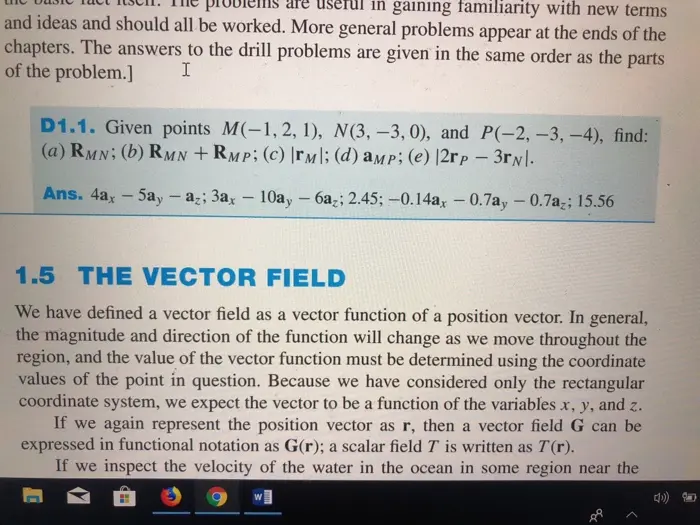
Transcribed Image Text:
in gaining familiarity with new terms
and ideas and should all be worked. More general problems appear at the ends of the
chapters. The answers to the drill problems are given in the same order as the parts
of the problem.]
I
D1.1. Given points M(-1, 2, 1), N(3, -3, 0), and P(-2, -3, -4), find:
(a) RMN; (b) RMN + RMP; (c) |гм; (d) amp; (e) | 2rp - 3rNl.
Ans. 4ax-5ay - az; 3ax - 10ay - 6az; 2.45; -0.14ax -0.7ay -0.7az; 15.56
1.5 THE VECTOR FIELD
We have defined a vector field as a vector function of a position vector. In general,
the magnitude and direction of the function will change as we move throughout the
region, and the value of the vector function must be determined using the coordinate
values of the point in question. Because we have considered only the rectangular
coordinate system, we expect the vector to be a function of the variables x, y, and z.
If we again represent the position vector as r, then a vector field G can be
expressed in functional notation as G(r); a scalar field T is written as 7(r).
If we inspect the velocity of the water in the ocean in some region near the
Thus,
B = B. ap
y(ax a)x(ay. a)
=-y sin
- x cos = -p sin² -p cos² = -p
B = -pa + zaz
= 4.4.
=
=
D1.5. (a) Give the rectangular coordinates of the point C(p
-115°, z= 2). (b) Give the cylindrical coordinates of the point D(x
-3.1, y = 2.6, z=-3). (c) Specify the distance from C to D.
Ans. C(x=-1.860, y = -3.99, z = 2); D(p = 4.05, = 140.0°, z=-3); 8.36
41))
g these results, we have
G
=r cos e cos (sin cot o a, + cos 0 cot o ao - 8%)
= A describes the general curvilinear coordinate system of which the
ircular cylindrical, and spherical coordinate systems are special cases.
on of this appendix could well be scanned now.
ENGINEERING ELECTROMAGNETICS
I
D1.7. Given the two points, C(-3, 2, 1) and D(r =5,0=20°, 6=-70°),
find: (a) the spherical coordinates of C; (b) the rectangular coordinates of D;
(c) the distance from C to D.
Ans. C(r= 3.74, 0 = 74.5°, = 146.3°); D(x = 0.585, y=-1.607, z = 4.70);
6.29
check_circle الجواب — حل مفصل خطوة بخطوة
hourglass_top
🔒
الحل الكامل متاح للمشتركين
اشترك في أرشيف الأسئلة لعرض هذا الحل وآلاف الحلول المفصلة خطوة بخطوة من معلمين معتمدين.