تم الحل ✓
categoryكيمياء
schoolبكالوريوس
event_available2026-07-14
السؤال
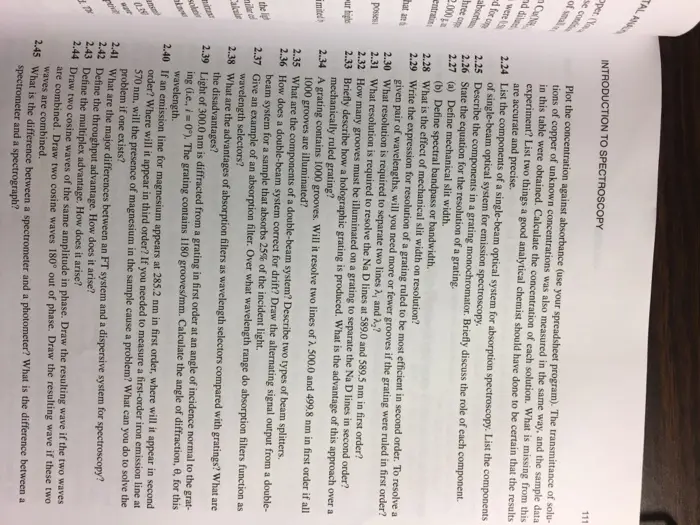
Transcribed Image Text:
TAL AN
Oper. (Y
se cont
of small
Cu
nd dil
were s
ed for com
absorb
hree m
2.000
entration
hat an
INTRODUCTION TO SPECTROSCOPY
111
Plot the concentration against absorbance (use your spreadsheet program). The transmittance of solu-
tions of copper of unknown concentrations was also measured in the same way, and the sample data
in this table were obtained. Calculate the concentration of each solution. What is missing from this
experiment? List two things a good analytical chemist should have done to be certain that the results
are accurate and precise.
2.24 List the components of a single-beam optical system for absorption spectroscopy. List the components
of single-beam optical system for emission spectroscopy.
2.25 Describe the components in a grating monochromator. Briefly discuss the role of each component.
2.26 State the equation for the resolution of a grating.
2.27
(a) Define mechanical slit width.
(b) Define spectral bandpass or bandwidth.
2.28
What is the effect of mechanical slit width on resolution?
2.29
2.30
posses
2.31
mited
the lig
milar
Calle
ter
salnir
kar
0.29
hoke
Write the expression for resolution of a grating ruled to be most efficient in second order. To resolve a
given pair of wavelengths, will you need more or fewer grooves if the grating were ruled in first order?
What resolution is required to separate two lines λ, and λ₂?
What resolution is required to resolve the Na D lines at 589.0 and 589.5 nm in first order?
2.32 How many grooves must be illuminated on a grating to separate the Na D lines in second order?
2.33 Briefly describe how a holographic grating is produced. What is the advantage of this approach over a
mechanically ruled grating?
2.34 A grating contains 1000 grooves. Will it resolve two lines of à 500.0 and 499.8 nm in first order if all
1000 grooves are illuminated?
2.35
2.36
What are the components of a double-beam system? Describe two types of beam splitters.
How does a double-beam system correct for drift? Draw the alternating signal output from a double-
beam system for a sample that absorbs 25% of the incident light.
2.37 Give an example of an absorption filter. Over what wavelength range do absorption filters function as
wavelength selectors?
2.38 What are the advantages of absorption filters as wavelength selectors compared with gratings? What are
the disadvantages?
2.39 Light of 300.0 nm is diffracted from a grating in first order at an angle of incidence normal to the grat-
ing (ie., i=0°). The grating contains 1180 grooves/mm. Calculate the angle of diffraction, e, for this
wavelength.
2.40 If an emission line for magnesium appears at 285.2 nm in first order, where will it appear in second
order? Where will it appear in third order? If you needed to measure a first-order iron emission line at
570 nm, will the presence of magnesium in the sample cause a problem? What can you do to solve the
problem if one exists?
2.41 What are the major differences between an FT system and a dispersive system for spectroscopy?
2.42 Define the throughput advantage. How does it arise?
2.43 Define the multiplex advantage. How does it arise?
2.44 Draw two cosine waves of the same amplitude in phase. Draw the resulting wave if the two waves
are combined. Draw two cosine waves 180° out of phase. Draw the resulting wave if these two
waves are combined.
2.45 What is the difference between a spectrometer and a photometer? What is the difference between a
spectrometer and a spectrograph?
110
UNDERGRADUATE INSTRUMENTAL ANAL
Calculate A, the absorbance, for each solution, and plot A against the concentration of copper. (Yo
do this using a spreadsheet program very easily.) Does the system, measured under these cond
conform to Beer's law over the entire concentration range? Is any deviation from the law of small
large magnitude? Suggest a plausible cause for any deviation.
2.13 An amount of 0.200 g of copper is dissolved in nitric acid. Excess ammonia is added to form Cu(N
and the solution is made up to 1 L. The following aliquots of the solution are taken and dilu
10.0 mL: 10.0, 8.0, 5.0, 4.0, 3.0, 2.0, and 1.0 mL. The absorbances of the diluted solution were
0.400, 0.250, 0.200, 0.150, 0.100, and 0.050, respectively. A series of samples was analyzed for copp
concentration by forming the Cu(NH,), complex and measuring the absorbance. The absorbance
were (a) 0.450, (b) 0.300, and (c) 0.200. What were the respective concentrations in the three coppe
solutions? If these three samples were obtained by weighing out separately (a) 1.000 g, (b) 2.000 g
(c) 3.000 g of sample and dissolving and diluting to 10.0 mL, what was the original concentration an
copper in each sample?
2.14 Describe the standard addition method for measuring concentration of an unknown. What are the
advantages of this method of calibration?
2.15 Describe the use of an internal standard for calibration. What characteristics must a species possess to
serve as an internal standard? What are the advantages of the internal standard method?
2.16 Describe what you would do for samples whose absorbances fell above the absorbance of your highest
calibration standard.
2.17 What range of % transmittance results in the smallest relative error for an instrument limited by
(a) noise in the thermal detector of an IR spectrometer? (b) shot noise?
2.18 What is A if the percentage of light absorbed is (a) 90%, (b) 99%, (c) 99.9%, and (d) 99.99%.
2.19 What is the purpose of having and measuring a reagent blank?
2.20 An optical cell containing a solution was placed in a beam of light. The original intensity of the ligh
was 100 units. After being passed through the solution, its intensity was 80 units. A second similar cell
containing more of the same solution was also placed in the light beam behind the first cell. Calculate
the intensity of radiation emerging from the second cell.
solution?
2.21 The transmittance of a solution of unknown concentration in a 1.00 cm cell is 0.700. The transmittance
of a standard solution of the same material is also 0,700. The concentration of the standard solution
is 100.0 ppm; the cell length of the standard is 4.00 cm. What is the concentration of the unknown
2.22 A solution contains 1.0 mg of KMnO/L. When measured in a 1.00 cm cell at 525 nm, the transm
tance was 0.300. When measured under similar conditions at 500 nm, the transmittance was 0.350
(a) Calculate the absorbance A at each wavelength. (b) Calculate the molar absorptivity at each wave
length. (c) What would 7 be if the cell length were in each case 2.00 cm? (d) Calculate the absorptivity
if concentration is in mg/L for the solution at each wavelength.
following data were obtained:
2.23 A series of standard ammoniacal copper solutions was prepared and the transmittance measured. The
Cu Concentration
0.20
Transmittance
0.900
Sample
0.40
060
check_circle الجواب — حل مفصل خطوة بخطوة
hourglass_top
🔒
الحل الكامل متاح للمشتركين
اشترك في أرشيف الأسئلة لعرض هذا الحل وآلاف الحلول المفصلة خطوة بخطوة من معلمين معتمدين.