تم الحل ✓
categoryرياضيات
schoolبكالوريوس
event_available2026-07-14
السؤال
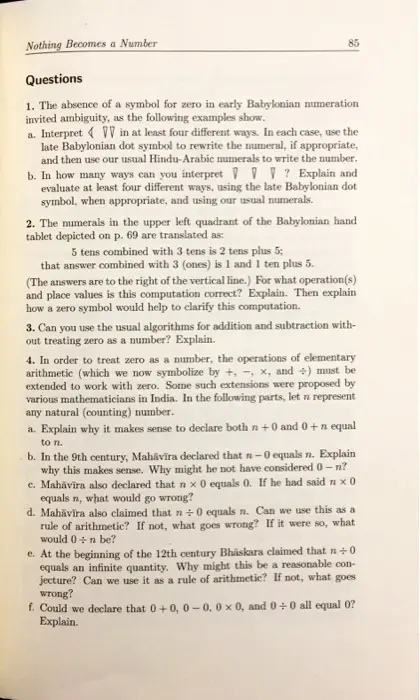
Transcribed Image Text:
Nothing Becomes a Number
Questions
1. The absence of a symbol for zero in early Babylonian numeration
invited ambiguity, as the following examples show.
a. Interpret in at least four different ways. In each case, use the
late Babylonian dot symbol to rewrite the numeral, if appropriate,
and then use our usual Hindu-Arabic numerals to write the number.
b. In how many ways can you interpret ? Explain and
evaluate at least four different ways, using the late Babylonian dot
symbol, when appropriate, and using our usual numerals.
2. The numerals in the upper left quadrant of the Babylonian hand
tablet depicted on p. 69 are translated as:
5 tens combined with 3 tens is 2 tens plus 5;
that answer combined with 3 (ones) is 1 and 1 ten plus 5.
(The answers are to the right of the vertical line.) For what operation(s)
and place values is this computation correct? Explain. Then explain
how a zero symbol would help to clarify this computation.
3. Can you use the usual algorithms for addition and subtraction with-
out treating zero as a number? Explain.
4. In order to treat zero as a number, the operations of elementary
arithmetic (which we now symbolize by +, -, x, and +) must be
extended to work with zero. Some such extensions were proposed by
various mathematicians in India. In the following parts, let n represent
any natural (counting) number.
a. Explain why it makes sense to declare both n +0 and 0+n equal
to n.
b. In the 9th century, Mahavira declared that n-0 equals n. Explain
why this makes sense. Why might he not have considered 0-n?
c. Mahavira also declared that n x 0 equals 0. If he had said n x 0
equals n, what would go wrong?
d. Mahavira also claimed that n + 0 equals n. Can we use this as a
rule of arithmetic? If not, what goes wrong? If it were so, what
would 0+ n be?
e. At the beginning of the 12th century Bhaskara claimed that n÷0
equals an infinite quantity. Why might this be a reasonable con-
jecture? Can we use it as a rule of arithmetic? If not, what goes
wrong?
f. Could we declare that 0+0, 0-0, 0 x 0, and 0+0 all equal 0?
Explain.
check_circle الجواب — حل مفصل خطوة بخطوة
hourglass_top
🔒
الحل الكامل متاح للمشتركين
اشترك في أرشيف الأسئلة لعرض هذا الحل وآلاف الحلول المفصلة خطوة بخطوة من معلمين معتمدين.