تم الحل ✓
categoryاقتصاد عام
schoolبكالوريوس
event_available2026-07-14
السؤال
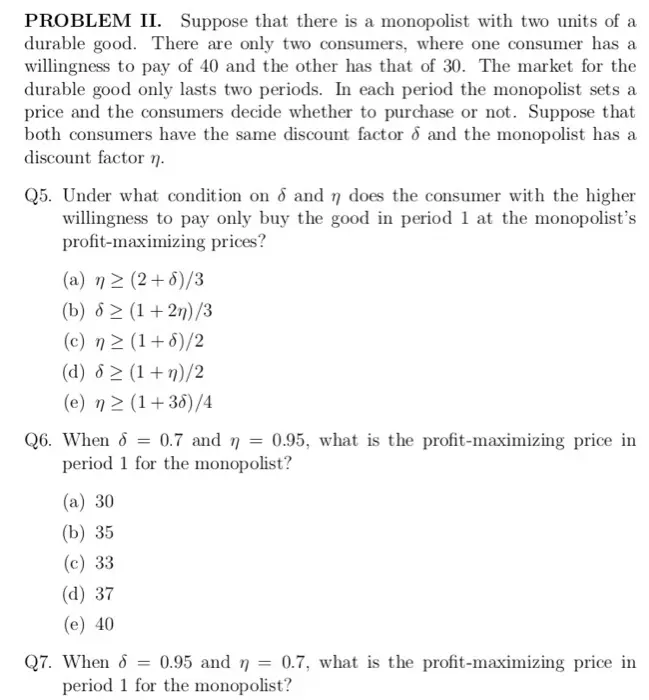
Transcribed Image Text:
PROBLEM II. Suppose that there is a monopolist with two units of a
durable good. There are only two consumers, where one consumer has a
willingness to pay of 40 and the other has that of 30. The market for the
durable good only lasts two periods. In each period the monopolist sets a
price and the consumers decide whether to purchase or not. Suppose that
both consumers have the same discount factor & and the monopolist has a
discount factor n.
Q5. Under what condition on 8 and ŋ does the consumer with the higher
willingness to pay only buy the good in period 1 at the monopolist's
profit-maximizing prices?
(a) n≥ (2+)/3
(b)
(1+2n)/3
(c) n≥ (1+5)/2
(d) ≥ (1+1)/2
(e)
Q6. When
(1+36)/4
= 0.7 and n = 0.95, what is the profit-maximizing price in
period 1 for the monopolist?
(a) 30
(b) 35
(c) 33
(d) 37
(e) 40
6
Q7. When = 0.95 and 7 = 0.7, what is the profit-maximizing price in
period 1 for the monopolist?
(a) 30
(b) 35
(c) 33
(d) 37
(e) 40
check_circle الجواب — حل مفصل خطوة بخطوة
hourglass_top
🔒
الحل الكامل متاح للمشتركين
اشترك في أرشيف الأسئلة لعرض هذا الحل وآلاف الحلول المفصلة خطوة بخطوة من معلمين معتمدين.