تم الحل ✓
categoryهندسة كيميائية
schoolبكالوريوس
event_available2026-07-14
السؤال
Transcribed Image Text:
➤ Problem 2.
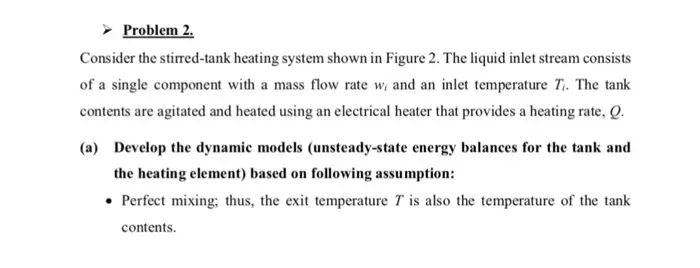
Consider the stirred-tank heating system shown in Figure 2. The liquid inlet stream consists
of a single component with a mass flow rate w, and an inlet temperature T. The tank
contents are agitated and heated using an electrical heater that provides a heating rate, Q.
(a) Develop the dynamic models (unsteady-state energy balances for the tank and
the heating element) based on following assumption:
Perfect mixing; thus, the exit temperature 7 is also the temperature of the tank
contents.
• The inlet and outlet flow rates are equal; thus ww and the liquid holdup V is
constant.
The density p and heat capacity C of the liquid are assumed to be constant. Thus
their temperature dependence is neglected.
Heat losses are negligible.
⚫ Energy transferred instantaneously from the heating element to the contents of the
tank.
⚫ Neglect the temperature gradients in the heating element that result from heat
conduction and assume that the element has a uniform temperature, Te. This
temperature can be interpreted as the average temperature for the heating element.
(b) Consider the models of the electrically heated stirred-tank system in section (a):
1. Drive transfer functions relating changes in outlet temperature T to changes in the
two input variables; heater Q (assuming no change in inlet temperature), and inlet
temperature Ti (for no change in heater input).
2. Show how these transfer functions are simplified when negligible thermal
capacitance of the heating element (m.C. →0) is assumed.
Wi
V
Heater
Figure 2: Stirred-tank heating with constant holdup, V, related to problem 2.
check_circle الجواب — حل مفصل خطوة بخطوة
hourglass_top
🔒
الحل الكامل متاح للمشتركين
اشترك في أرشيف الأسئلة لعرض هذا الحل وآلاف الحلول المفصلة خطوة بخطوة من معلمين معتمدين.