تم الحل ✓
categoryرياضيات
schoolبكالوريوس
event_available2026-07-14
السؤال
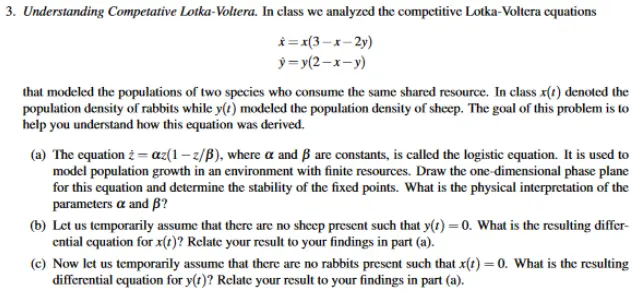
Transcribed Image Text:
3. Understanding Competative Lotka-Voltera. In class we analyzed the competitive Lotka-Voltera equations
x=x(3-x-2y)
y=y(2-x-y)
that modeled the populations of two species who consume the same shared resource. In class x(t) denoted the
population density of rabbits while y(t) modeled the population density of sheep. The goal of this problem is to
help you understand how this equation was derived.
(a) The equation=az(1-z/B), where a and ẞ are constants, is called the logistic equation. It is used to
model population growth in an environment with finite resources. Draw the one-dimensional phase plane
for this equation and determine the stability of the fixed points. What is the physical interpretation of the
parameters a and ẞ?
(b) Let us temporarily assume that there are no sheep present such that y(t)=0. What is the resulting differ-
ential equation for x(t)? Relate your result to your findings in part (a).
(c) Now let us temporarily assume that there are no rabbits present such that x(t)=0. What is the resulting
differential equation for y(t)? Relate your result to your findings in part (a).
(d) In general y(t) +0 and x(t) 0. Therefore we have to understand the physical meaning of the term -2xy
in the equation for x and the term -xy in the equation for y.
i. If there are many sheep (y(t) is large) what happens to the growth rate of rabbits?
ii. If there are many rabbits (x(t) is large) what happens to the growth rate of sheep?
iii. Is the growth rate of rabbits affected by the number of sheep in the same amount as the growth rate of
sheep is affected by the number of rabbits?
iv. Propose a biologically explanantion that justifies why we should include the terms -2xy and -xy in
our differential equation.
check_circle الجواب — حل مفصل خطوة بخطوة
hourglass_top
🔒
الحل الكامل متاح للمشتركين
اشترك في أرشيف الأسئلة لعرض هذا الحل وآلاف الحلول المفصلة خطوة بخطوة من معلمين معتمدين.