تم الحل ✓
categoryرياضيات
schoolبكالوريوس
event_available2026-07-14
السؤال
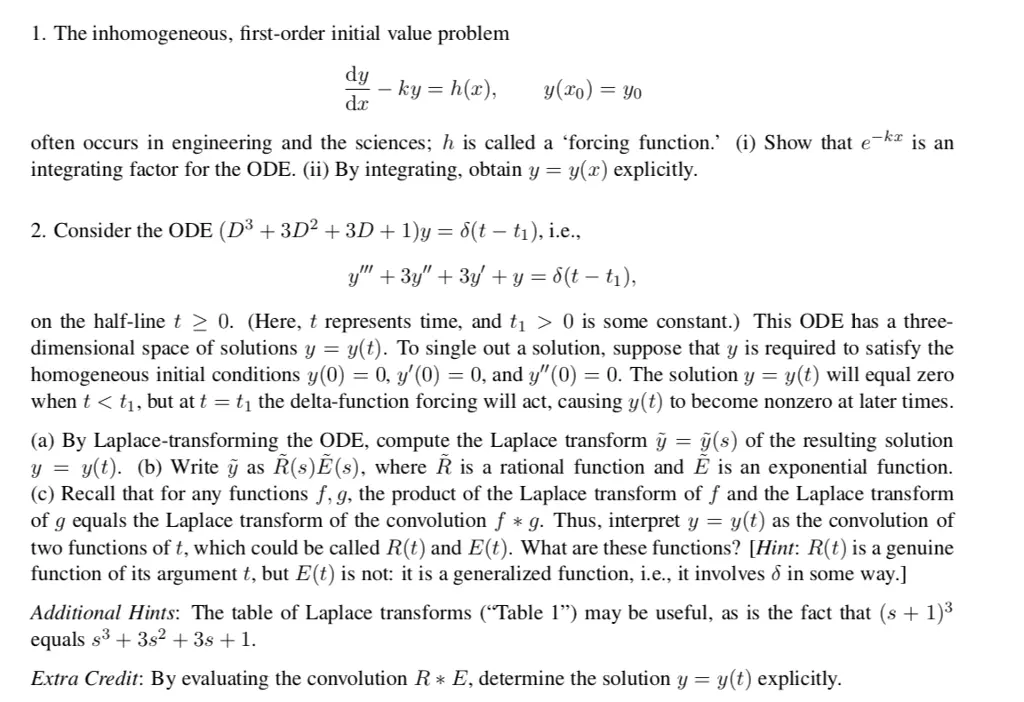
Transcribed Image Text:
1. The inhomogeneous, first-order initial value problem
dy
- ky = h(x),
y(x0) = yo
dx
often occurs in engineering and the sciences; h is called a 'forcing function.' (i) Show that e-kx is an
integrating factor for the ODE. (ii) By integrating, obtain y = y(x) explicitly.
2. Consider the ODE (D3 + 3D² + 3D + 1)y = 8(t − t₁), i.e.,
y"" +3y" + 3y+ y = 8(t − t₁),
on the half-line t≥0. (Here, t represents time, and t₁ > 0 is some constant.) This ODE has a three-
dimensional space of solutions y = y(t). To single out a solution, suppose that y is required to satisfy the
homogeneous initial conditions y(0) = 0, y'(0) = 0, and y"(0) = 0. The solution y = y(t) will equal zero
when t<t₁, but at t = t₁ the delta-function forcing will act, causing y(t) to become nonzero at later times.
(a) By Laplace-transforming the ODE, compute the Laplace transform ỹ = y(s) of the resulting solution
y = y(t). (b) Write y as Ŕ(s)Ẽ(s), where R is a rational function and Ẽ is an exponential function.
(c) Recall that for any functions f, g, the product of the Laplace transform of f and the Laplace transform
of g equals the Laplace transform of the convolution f * g. Thus, interpret y = y(t) as the convolution of
two functions of t, which could be called R(t) and E(t). What are these functions? [Hint: R(t) is a genuine
function of its argument t, but E(t) is not: it is a generalized function, i.e., it involves & in some way.]
Additional Hints: The table of Laplace transforms ("Table 1") may be useful, as is the fact that (s + 1)3
equals s3 +382 +38 +1.
Extra Credit: By evaluating the convolution R✶ E, determine the solution y = y(t) explicitly.
3. Many special functions have integral representations: formulas that express them as definite integrals.
(Typically, the argument of the special function appears as a parameter in the integrand.) One such repre-
sentation, for the Bessel function Jo, is
Jo(x)
1
==
cos(x sin 0) do.
πT 0
That is, Jo(x) is the average value of cos(x sin 0) on the interval 0 < 0 < π.
Show that this is plausible, in the sense that if y = y(x) is the right-hand side, then y will satisfy the p = 0
case of the Bessel ODE
dy
x²d²y
dx2 dx
+x
+ (x² = p²)y = 0.
-
Hint: An integration by parts may be useful; if carefully done, it may lead to cancellation of terms.
Comment: The preceding is not a full proof of the validity of the integral representation formula, because
any Bessel ODE has a two-dimensional space of solutions, and you would need to check that the right-hand
side of the formula is the solution that we call Jo(x). But it turns out that it is.
4. (i) Give a simple example of a linear, homogeneous second-order ODE with independent variable x,
which has only one (finite) singular point; namely, the point x = 1. Your ODE should be chosen so that this
singular point is a regular one. (ii) Calculate the two characteristic exponents of the singular point x = 1.
(iii) Apply the change of variable x = 1/ε, i.e., § = 1/x, to your ODE, obtaining a transformed ODE,
the independent variable of which is rather than x. (iv) Examine the point = 0, which corresponds to
x = ∞. For the transformed ODE, is = 0 a singular point, and if so, is it regular or irregular? (v) If ε = 0
is regular, calculate its characteristic exponents.
5. In Problem 31(c) of Section 5.7, you (in effect) computed the coefficients in the Fourier sine series
representation
f(x) = B. sin nz,
n=1
> x>
for the function f = f(x) that equals 1 if 0 < x </2, equals -1 if -π/2 < x < 0, and equals zero at
other points in (-, π). (Actually, the problem was phrased as an expansion on (0, 7) rather than (-π, π);
but if f(x), like each expansion function sinna, is viewed as an odd function of x, it amounts to the same
thing.)
It is easy to see that f = F', i.e., f is the derivative of F, where F = F(x) equals |x|-(/2) if
-π/2 < x </2, and equals zero at other points in (-,π). From this fact, deduce a Fourier cosine
series for F, i.e.,
F(x) = An cos nx,
-<x<
by integrating the sine series for f, term by term.
Hint: The only part of this problem that is even slightly difficult is the calculation of the (constant) n = 0
term in the Fourier cosine series for F, i.e., the coefficient Ao. It cannot be deduced from the known Fourier
sine series for f = F', because the derivative of a constant is zero. You must remember that the n = 0 term
in a cosine series is what an electrical engineer would call the 'DC component,' which means that the n = 0
term in the cosine series for F, i.e., the coefficient Ao, must be the average value of F on the interval in
question.
6. A 'parabolic' coordinate system uses coordinates (§, n, 0) which in a sense lie between spherical and
cylindrical coordinates. The coordinates §, n equal r-z and r+z respectively, where r = √√√x² + y²+ z²,
and the third coordinate is the usual azimuthal angle: the longitude, i.e., the angle around the z-axis. It
can be shown that the Laplacian operator V² can be written in terms of parabolic coordinates thus:
4
=
Στη
;[(૬
მ2 მ
+
θε
მ
+
+
2
1 82
+
ξη 202
The Helmholtz equation V2f- f = 0 is a PDE that is a modified version of Laplace's equation. Like the
Laplace equation, it separates in many coordinate systems, and one of them is the just-described system of
parabolic coordinates.
=
=
To prove this, consider a 'product form' solution f fp(§,1,0) E()H(n)(0) of the Helmholtz
equation, and in particular (to keep things simple), consider an axisymmetric solution that does not depend
on the azimuthal angle 0, i.e., f = fp(§, n, 0) = =(§)H(n). Substitute f = fp into the Helmholtz equation,
and multiply the entire resulting equation, term by term, by (§ + n)/fp. The terms on the left-hand side
should then be of two types: ones that depend only on ε, and ones that depend only on n. The sum of the
terms must therefore equal a constant (the 'separation constant'), and the sum of the n terms must equal its
negative. In this way, derive a second-order ODE satisfied by (E), and a very similar second-order ODE
satisfied by H(n).
=
Extra Credit. Substitute (§) L() exp(-/2) into the just-derived ODE satisfied by E(S), and show
that the function L(S) must satisfy Laguerre's equation, which is the ODE given in Exercise 4.24. (The
independent variable in that ODE must of course be changed from x to §.) Thus, Laguerre functions (like
Legendre polynomials, Bessel functions, etc.) can appear if one constructs solutions to a simple PDE by the
method of separation of variables.
check_circle الجواب — حل مفصل خطوة بخطوة
hourglass_top
🔒
الحل الكامل متاح للمشتركين
اشترك في أرشيف الأسئلة لعرض هذا الحل وآلاف الحلول المفصلة خطوة بخطوة من معلمين معتمدين.