تم الحل ✓
categoryفيزياء
schoolبكالوريوس
event_available2026-07-14
السؤال
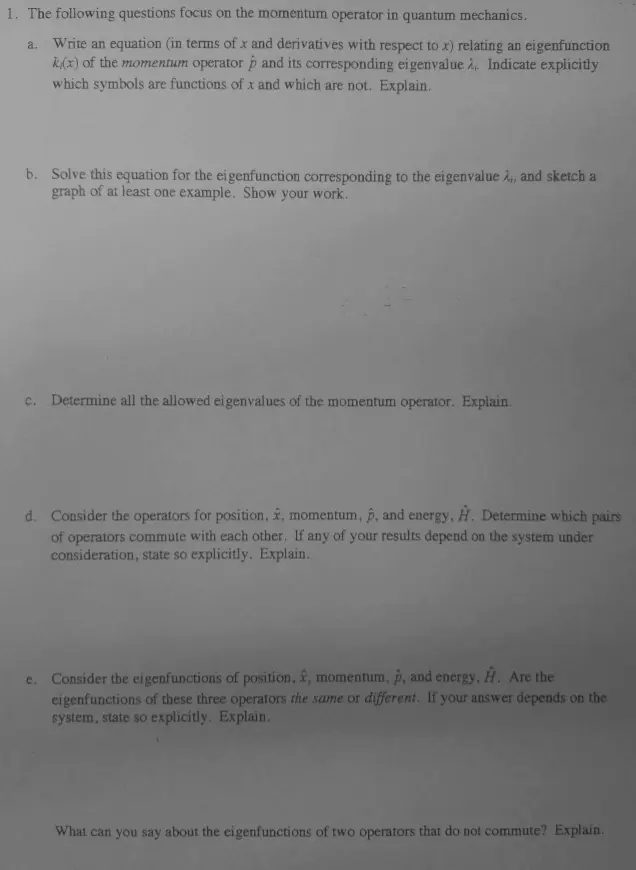
Transcribed Image Text:
1. The following questions focus on the momentum operator in quantum mechanics.
a. Write an equation (in terms of x and derivatives with respect to x) relating an eigenfunction
k(x) of the momentum operator p and its corresponding eigenvalue 2 Indicate explicitly
which symbols are functions of x and which are not. Explain.
b. Solve this equation for the eigenfunction corresponding to the eigenvalue A, and sketch a
graph of at least one example. Show your work.
c. Determine all the allowed eigenvalues of the momentum operator. Explain.
d. Consider the operators for position, &, momentum, p, and energy, Ĥ. Determine which pairs
of operators commute with each other. If any of your results depend on the system under
consideration, state so explicitly. Explain.
e. Consider the eigenfunctions of position, &, momentum, p, and energy, Ĥ. Are the
eigenfunctions of these three operators the same or different. If your answer depends on the
system, state so explicitly. Explain.
What can you say about the eigenfunctions of two operators that do not commute? Explain.
QM
HW-2
f.
Energy
Measurements
Position
Measurements
Momentum
Measurements
Homework: Position, momentum, and energy measurements
Table 1: Number of Possible
Measurement Outcomes (at a later time)
Energy
Momentum
Position
Eigenstate Eigenstate Eigenstate
Table 2: Time-dependence of
Probabilities of Possible Outcomes
Energy
Eigenstate
Position
Momentum
Eigenstate Eigenstate
Use your results from the tutorial to fill in the portions of the table above that correspond to
position and energy measurements. Briefly explain how you were able to determine these
answers.
g. Complete the remaining portions of the table for momentum measurements and eigenstates of
momentum. If your results depend on the system, state so explicitly. Explain how you
determined your answers. (Hint: Consider your answers to the questions on the previous
page.)
h. Consider a hypothetical operator, Ô, that commutes with the Hamiltonian.
i. If you started in an eigenstate of O, which observables would have multiple possible
results? Explain.
ii. If you started in an eigenstate of O, which observables would have probabilities that
depend on time? Explain.
check_circle الجواب — حل مفصل خطوة بخطوة
hourglass_top
🔒
الحل الكامل متاح للمشتركين
اشترك في أرشيف الأسئلة لعرض هذا الحل وآلاف الحلول المفصلة خطوة بخطوة من معلمين معتمدين.