تم الحل ✓
categoryرياضيات
schoolبكالوريوس
event_available2026-07-14
السؤال
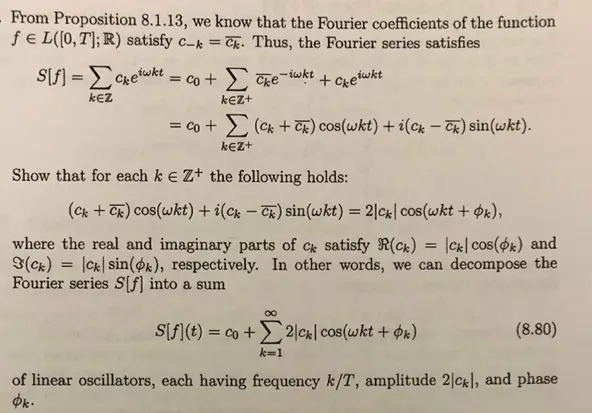
Transcribed Image Text:
- From Proposition 8.1.13, we know that the Fourier coefficients of the function
fe L([0,T]; R) satisfy c-k Ck. Thus, the Fourier series satisfies
=
=
SfCkeiwkt
= co+Cewkt
kЄZ
+ Che¹wkt
kЄZ+
=co+(Ck+C) cos(wkt) + i(ck-ck) sin(wkt).
kЄZ+
Show that for each ke Z+ the following holds:
(Ck+Ck) cos(wkt) + i(ck - Ck) sin(wkt) = 2|ck| cos(wkt + k),
==
where the real and imaginary parts of ck satisfy R(ck) = |ck| cos(ok) and
3(Ck) |ck| sin(ok), respectively. In other words, we can decompose the
Fourier series S[f] into a sum
=
S[f](t)=co+2|ck| cos(wkt + k)
k=1
(8.80)
of linear oscillators, each having frequency k/T, amplitude 2|ck|, and phase
Фк.
Proposition 8.1.13. If ƒ e L2([0,T]; R), then Ckck for each kЄ Z.
we have
Proof. Since f(t) = f(t) and e-iwkteikt,
1
Ck=
(t)et= = f(t)edt = ck-
D
check_circle الجواب — حل مفصل خطوة بخطوة
hourglass_top
🔒
الحل الكامل متاح للمشتركين
اشترك في أرشيف الأسئلة لعرض هذا الحل وآلاف الحلول المفصلة خطوة بخطوة من معلمين معتمدين.