تم الحل ✓
categoryإدارة أعمال
schoolبكالوريوس
event_available2026-07-14
السؤال
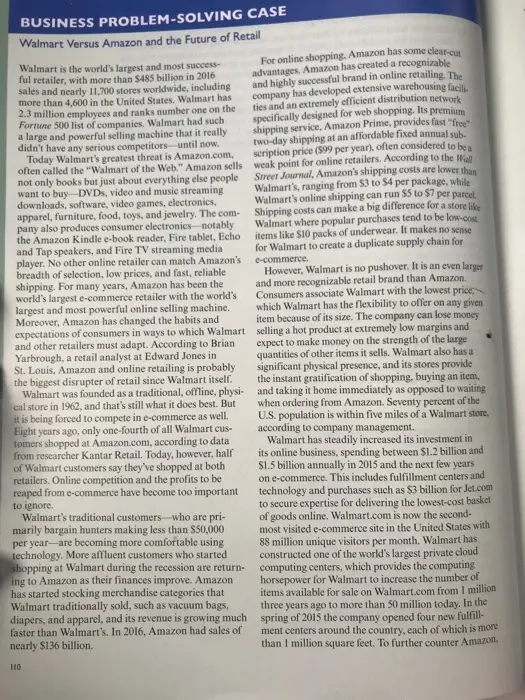
Transcribed Image Text:
BUSINESS PROBLEM-SOLVING CASE
Walmart Versus Amazon and the Future of Retail
Walmart is the world's largest and most success-
ful retailer, with more than $485 billion in 2016
sales and nearly 11,700 stores worldwide, including
more than 4,600 in the United States. Walmart has
2.3 million employees and ranks number one on the
Fortune 500 list of companies. Walmart had such
a large and powerful selling machine that it really
didn't have any serious competitors until now.
Today Walmart's greatest threat is Amazon.com,
often called the "Walmart of the Web." Amazon sells
not only books but just about everything else people
want to buy DVDs, video and music streaming
downloads, software, video games, electronics,
apparel, furniture, food, toys, and jewelry. The com-
pany also produces consumer electronics-notably
the Amazon Kindle e-book reader, Fire tablet, Echo
and Tap speakers, and Fire TV streaming media
player. No other online retailer can match Amazon's
breadth of selection, low prices, and fast, reliable
shipping. For many years, Amazon has been the
world's largest e-commerce retailer with the world's
largest and most powerful online selling machine.
Moreover, Amazon has changed the habits and
expectations of consumers in ways to which Walmart
and other retailers must adapt. According to Brian
Yarbrough, a retail analyst at Edward Jones in
St. Louis, Amazon and online retailing is probably
the biggest disrupter of retail since Walmart itself.
Walmart was founded as a traditional, offline, physi-
cal store in 1962, and that's still what it does best. But
it is being forced to compete in e-commerce as well.
Eight years ago, only one-fourth of all Walmart cus-
tomers shopped at Amazon.com, according to data
from researcher Kantar Retail. Today, however, half
of Walmart customers say they've shopped at both
retailers. Online competition and the profits to be
reaped from e-commerce have become too important
to ignore.
Walmart's traditional customers-who are pri-
marily bargain hunters making less than $50,000
per year are becoming more comfortable using
technology. More affluent customers who started
shopping at Walmart during the recession are return-
ing to Amazon as their finances improve. Amazon
has started stocking merchandise categories that
Walmart traditionally sold, such as vacuum bags,
diapers, and apparel, and its revenue is growing much
faster than Walmart's. In 2016, Amazon had sales of
nearly $136 billion.
110
For online shopping. Amazon has some clear-cut
advantages. Amazon has created a recognizable
and highly successful brand in online retailing. The
company has developed extensive warehousing facili
ties and an extremely efficient distribution network
specifically designed for web shopping. Its premium
shipping service, Amazon Prime, provides fast "free"
two-day shipping at an affordable fixed annual sub.
scription price ($99 per year), often considered to be a
weak point for online retailers. According to the Wall
Street Journal, Amazon's shipping costs are lower than
Walmart's, ranging from $3 to $4 per package, while
Walmart's online shipping can run $5 to $7 per parcel
Shipping costs can make a big difference for a store like
Walmart where popular purchases tend to be low-cost
items like $10 packs of underwear. It makes no sense
for Walmart to create a duplicate supply chain for
e-commerce.
However, Walmart is no pushover. It is an even larger
and more recognizable retail brand than Amazon.
Consumers associate Walmart with the lowest price,
which Walmart has the flexibility to offer on any given
item because of its size. The company can lose money
selling a hot product at extremely low margins and
expect to make money on the strength of the large
quantities of other items it sells. Walmart also has a
significant physical presence, and its stores provide
the instant gratification of shopping, buying an item,
and taking it home immediately as opposed to waiting
when ordering from Amazon. Seventy percent of the
U.S. population is within five miles of a Walmart store,
according to company management.
Walmart has steadily increased its investment in
its online business, spending between $1.2 billion and
$1.5 billion annually in 2015 and the next few years
on e-commerce. This includes fulfillment centers and
technology and purchases such as $3 billion for Jet.com
to secure expertise for delivering the lowest-cost basket
of goods online. Walmart.com is now the second-
most visited e-commerce site in the United States with
88 million unique visitors per month. Walmart has
constructed one of the world's largest private cloud
computing centers, which provides the computing
horsepower for Walmart to increase the number of
items available for sale on Walmart.com from I million
three years ago to more than 50 million today. In the
spring of 2015 the company opened four new fulfill-
ment centers around the country, each of which is more
than 1 million square feet. To further counter Amazon.
with Information Systems
Walmart introduced its own free two-day shipping pro-
gram for orders totaling more than $35.
New technology will also give Walmart more exper
tise in improving the product recommendations for
web visitors to Walmart.com, using smartphones as
a marketing channel, and personalizing the shopping
experience. Walmart has been steadily adding new
applications to its mobile and online shopping channels
and is expanding its integration with social networks
such as Pinterest.
More than half of Walmart customers own smart-
phones. Walmart has designed its mobile app to maxi-
mize Walmart's advantage over Amazon: its physical
locations. About 140 million people visit a Walmart
store each week. The app's Walmart Pay feature
enables users to quickly, easily and securely pay with
their smartphones in all Walmart stores. Users link a
credit card or bank account to the app. At checkout,
they can just scan the phone to pay rather than pulling
out their wallets. The app can also store shopping lists,
save wish lists, and arrange online orders. About
22 million people now use the app as they shop.
The Walmart website uses software to monitor prices
at competing retailers in real time and lower its online
prices if necessary. The company is also doubling
inventory sold from third-party retailers in its online
marketplace and tracking patterns in search and social
media data to help it select more trendy products. This
strikes directly at Amazon's third-party marketplace,
which accounts for a significant revenue stream for
Amazon. Additionally, Walmart is expanding its online
offerings to include upscale items like $146 Nike sun-
glasses and wine refrigerators costing more than $2,500
to attract customers who never set foot in a Walmart
store. A new Product Content Collection System will
facilitate vendors sending their product catalogs to
Walmart, and the product information will then be
available online.
Walmart's commitment to e-commerce is not
phones for home delivery, through in-store pickup, or
by wandering down the aisles of a Walmart superstore.
Walmart is aiming to be the world's biggest omnichan-
nel retailer.
designed to replicate Amazon's business model.
Instead, CEO Doug McMillon is crafting a strategy
that gives consumers the best of both worlds-what
is called an omnichannel approach to retailing.
Walmart's management believes the company's advan-
tage is that it is not a pure-play e-commerce retailer
and that customers want some real interaction with
physical stores as well as digital. Walmart will sell vig-
orously through the web and also in its physical stores,
retaining its hallmark everyday low prices and wide
product assortment in both channels and using its large
network of stores as distribution points. Walmart will
closely integrate online shopping and fulfillment with
its physical stores so that customers can shop how-
ever they want, whether it's ordering on their mobile
Amazon is working on expanding its selection of
goods to be as exhaustive as Walmart's. Amazon has
website for a number of years, and it has dramatically
allowed third-party sellers to sell goods through its
expanded product selection via acquisitions such as its
2009 purchase of online shoe shopping site Zappos.com
to give the company an edge in footwear. Amazon
has been building its grocery offerings, with Amazon
Prime, Prime Now, Prime Pantry, and Amazon Fresh
offering delivery times as short as an hour in some
cases.
It looks like Amazon is trying to innovate in physical
retail store sales as well as online. Amazon has opened
other U.S. locations featuring Amazon electronic
retail bookstores in Seattle, Chicago, San Diego, and
devices as well as books. It is thinking about moving
into the grocery business as well as retail stores for
that lend themselves less easily to online purchasing
furniture and appliances. These are retail experiences
because customers like to see and feel these types of
goods in person. Amazon set up a physical grocery
store in downtown Seattle called Amazon Go that is
designed around an app that is able to place the items
customers buy in a digital shopping cart so they can
leave the store without waiting in a checkout line. The
system automatically charges the credit card linked to
the customer's Amazon account and even knows when
that person puts something back.
Amazon continues to build more fulfillment centers
closer to urban centers and expand its same-day deliv-
ery services, and it has a supply chain optimized for
online commerce that Walmart just can't match. It now
has more than 100 warehouses from which to pack-
age and ship goods. Warehouses speed up Amazon's
shipping, encouraging users to shop more at Amazon,
and the cost of these centers as a portion of Amazon's
operations is decreasing. Amazon is building up its
own delivery operation to compete with UPS, FedEx,
and the U.S. Postal Service by offering better delivery
and lower costs for both its own customers and possibly
those of other retailers. Both Amazon and Walmart
are experimenting with drones to accelerate fulfillment
and delivery. But Walmart has thousands of stores, one
in almost every neighborhood, which Amazon won't
ever be able to replicate.
The winner of this epic struggle will be the company
that leverages its advantage better. Walmart's technol-
ogy initiative looks promising, but it still has work
to do before its local stores are anything more than
local stores. Can Walmart successfully move to an
112
omnichannel strategy? Can Amazon's business model
work for physical retail store sales? Which giant will
dominate future retailing?
Sources: Rachel Abrams, "Walmart, with Amazon in Its Cross Hairs,
Posts E-Commerce Gains," New York Times, May 18, 2017; William
White, "Walmart ShippingPass to Be Replaced by Free Two-Day Shipping."
InvestorPlace, January 31, 2017; Nick Wingfield, "Amazon's Ambitions
Unboxed: Stores for Furniture, Appliances and More," New York Times,
March 25, 2017, and "Amazon's Living Lab: Reimagining Retail on Seattle
Streets," New York Times, February 12, 2017; Tim Denman, "Walmart's
Part I: Information Systems in the Digital Age
Plan for Worldwide E-Commerce Domination," Info Systems News,
November 21, 2016; Greg Bensinger and Laura Stevens, "Amazon's Newest
Ambition: Competing Directly with UPS and FedEx," Wall Street Journal,
September 27, 2016; Rachel Abrams, "Walmart Outperforms Estimates, but
Online Retail Lags," New York Times, May 19, 2016; Nathan Olivarez-Giles,
"Amazon's Alexa Now Lets You Order Tens of Millions of Products with
Your Voice," Wall Street Journal, July 1, 2016; Farhad Manjoo, "How Ama-
zon's Long Game Yielded a Retail Juggernaut," New York Times, November
19, 2015; Brian O'Keefe, "The Man Who's Reinventing Walmart," Fortune,
June 4, 2015; and Nathan Layne, "Wal-Mart Eyes Amazon in Potentially
Costly E-commerce Battle," Reuters, May 20, 2015.
CASE STUDY QUESTIONS
3-13 Analyze Walmart and Amazon.com using the
competitive forces and value chain models.
3-14 Compare Walmart and Amazon's business
models and business strategies.
3-15 What role does information technology play
in each of these businesses? How is it helping
them refine their business strategies?
3-16 Which company will dominate retailing?
Explain your answer.
MyLab MIS
check_circle الجواب — حل مفصل خطوة بخطوة
hourglass_top
🔒
الحل الكامل متاح للمشتركين
اشترك في أرشيف الأسئلة لعرض هذا الحل وآلاف الحلول المفصلة خطوة بخطوة من معلمين معتمدين.