تم الحل ✓
categoryهندسة ميكانيكية
schoolبكالوريوس
event_available2026-07-14
السؤال
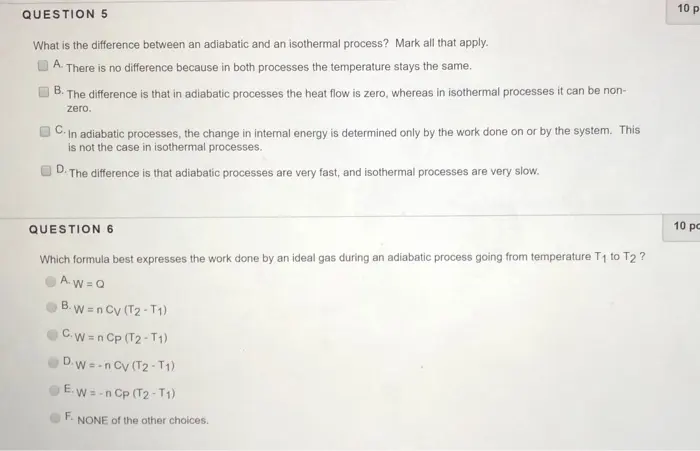
Transcribed Image Text:
QUESTION 5
What is the difference between an adiabatic and an isothermal process? Mark all that apply.
A. There is no difference because in both processes the temperature stays the same.
B.
The difference is that in adiabatic processes the heat flow is zero, whereas in isothermal processes it can be non-
zero.
In adiabatic processes, the change in internal energy is determined only by the work done on or by the system. This
is not the case in isothermal processes.
D. The difference is that adiabatic processes are very fast, and isothermal processes are very slow.
QUESTION 6
Which formula best expresses the work done by an ideal gas during an adiabatic process going from temperature T1 to T2?
A. W=Q
B. W = n Cy (T2-T1)
C. W = n Cp (T2-T1)
D.W=-n CV (T2-T1)
E.W-n Cp (T2-T1)
F.
NONE of the other choices.
10 P
10 pc
QUESTION 8
In deriving the relation pVY = constant for adiabatic processes of an ideal gas, which of the following principles are
used? (Mark all that apply.)
A.
Ideal Gas Law pV = nRT
B.
C.
D.
E.
Internal energy change dU = n CV dT
Molar heat capacity difference Cp CV = R
Heat capacity ratio y = Cp/CV
1st Law of Thermodynamics dU = dQ - W
F.
NONE of the other choices.
QUESTION 9
P
C
V
An ideal gas is taken around the cycle shown in this pV-diagram, from a to c to b and back to a. Process ac is at constant
pressure, process cb is adiabatic, and process ba is at constant volume.
For process cb, which statement is correct?
A.
B.
C.
D.
Q>0, W> 0, and the change in internal energy AU = 0.
Q>0, W> 0, and the change in internal energy AU > 0.
Q=0, W> 0, and the change in internal energy AU < 0.
Q=0, W<0, and the change in internal energy AU > 0.
check_circle الجواب — حل مفصل خطوة بخطوة
hourglass_top
🔒
الحل الكامل متاح للمشتركين
اشترك في أرشيف الأسئلة لعرض هذا الحل وآلاف الحلول المفصلة خطوة بخطوة من معلمين معتمدين.