تم الحل ✓
categoryفيزياء
schoolبكالوريوس
event_available2026-07-14
السؤال
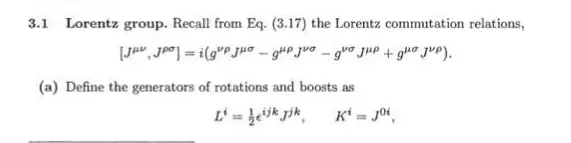
Transcribed Image Text:
3.1 Lorentz group. Recall from Eq. (3.17) the Lorentz commutation relations,
(a) Define the generators of rotations and boosts as
L' = jk jik K₁ =Joi
where i, j, k = 1,2,3. An infinitesimal Lorentz transformation can then be writ-
ten
(1-10-L-iẞ-K)0.
Write the commutation relations of these vector operators explicitly. (For exam-
ple, [L, Liek L.) Show that the combinations
J+=(L+K) and J = (L-iK)
commute with one another and separately satisfy the commutation relations of
angular momentum.
(b) The finite-dimensional representations of the rotation group correspond precisely
to the allowed values for angular momentum: integers or half-integers. The result
of part (a) implies that all finite-dimensional representations of the Lorentz group
correspond to pairs of integers or half integers, (j+j-), corresponding to pairs of
representations of the rotation group. Using the fact that J =σ/2 in the spin-
1/2 representation of angular momentum, write explicitly the transformation
laws of the 2-component objects transforming according to the (4,0) and (0.)
representations of the Lorentz group. Show that these correspond precisely to
the transformations of L and R given in (3.37).
(c) The identity = -2002 allows us to rewrite the L transformation in the
unitarily equivalent form
where
*(1+10+B),
². Using this law, we can represent the object that transforms
as (,) as a 2 x 2 matrix that has the R transformation law on the left and.
simultaneously, the transposed & transformation on the right. Parametrize this
matrix as
Vo+V3 V1-iv2\
+iV2 Vo-v3
Show that the object V transforms as a 4-vector.
check_circle الجواب — حل مفصل خطوة بخطوة
hourglass_top
🔒
الحل الكامل متاح للمشتركين
اشترك في أرشيف الأسئلة لعرض هذا الحل وآلاف الحلول المفصلة خطوة بخطوة من معلمين معتمدين.