تم الحل ✓
categoryفيزياء
schoolبكالوريوس
event_available2026-07-14
السؤال
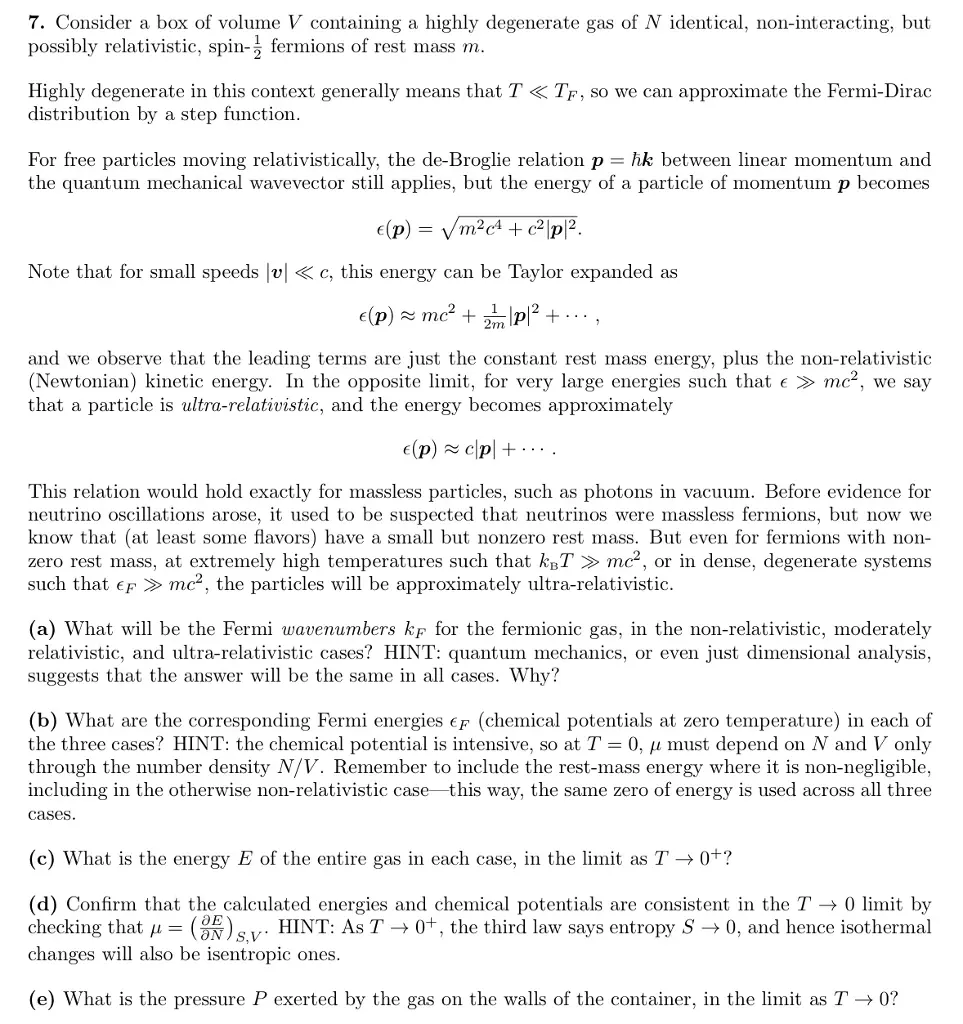
Transcribed Image Text:
7. Consider a box of volume V containing a highly degenerate gas of N identical, non-interacting, but
possibly relativistic, spin- fermions of rest mass m.
Highly degenerate in this context generally means that T < TF, so we can approximate the Fermi-Dirac
distribution by a step function.
For free particles moving relativistically, the de-Broglie relation p = hk between linear momentum and
the quantum mechanical wavevector still applies, but the energy of a particle of momentum p becomes
€(p) = √√m² c4 + c² |p|2.
Note that for small speeds |v| <c, this energy can be Taylor expanded as
(p) mc² + P²+
and we observe that the leading terms are just the constant rest mass energy, plus the non-relativistic
(Newtonian) kinetic energy. In the opposite limit, for very large energies such that e»mc², we say
that a particle is ultra-relativistic, and the energy becomes approximately
€(p) ≈c|p|+
This relation would hold exactly for massless particles, such as photons in vacuum. Before evidence for
neutrino oscillations arose, it used to be suspected that neutrinos were massless fermions, but now we
know that (at least some flavors) have a small but nonzero rest mass. But even for fermions with non-
zero rest mass, at extremely high temperatures such that kT »mc², or in dense, degenerate systems
such that EF »mc², the particles will be approximately ultra-relativistic.
(a) What will be the Fermi wavenumbers kp for the fermionic gas, in the non-relativistic, moderately
relativistic, and ultra-relativistic cases? HINT: quantum mechanics, or even just dimensional analysis,
suggests that the answer will be the same in all cases. Why?
(b) What are the corresponding Fermi energies F (chemical potentials at zero temperature) in each of
the three cases? HINT: the chemical potential is intensive, so at T = 0, μ must depend on N and V only
through the number density N/V. Remember to include the rest-mass energy where it is non-negligible,
including in the otherwise non-relativistic case this way, the same zero of energy is used across all three
cases.
(c) What is the energy E of the entire gas in each case, in the limit as T0+?
(d) Confirm that the calculated energies and chemical potentials are consistent in the T0 limit by
checking that = (3) sy. HINT: As T→ 0+, the third law says entropy S → 0, and hence isothermal
changes will also be isentropic ones.
S,V
(e) What is the pressure P exerted by the gas on the walls of the container, in the limit as T→ 0?
check_circle الجواب — حل مفصل خطوة بخطوة
hourglass_top
🔒
الحل الكامل متاح للمشتركين
اشترك في أرشيف الأسئلة لعرض هذا الحل وآلاف الحلول المفصلة خطوة بخطوة من معلمين معتمدين.