تم الحل ✓
categoryرياضيات
schoolبكالوريوس
event_available2026-07-14
السؤال
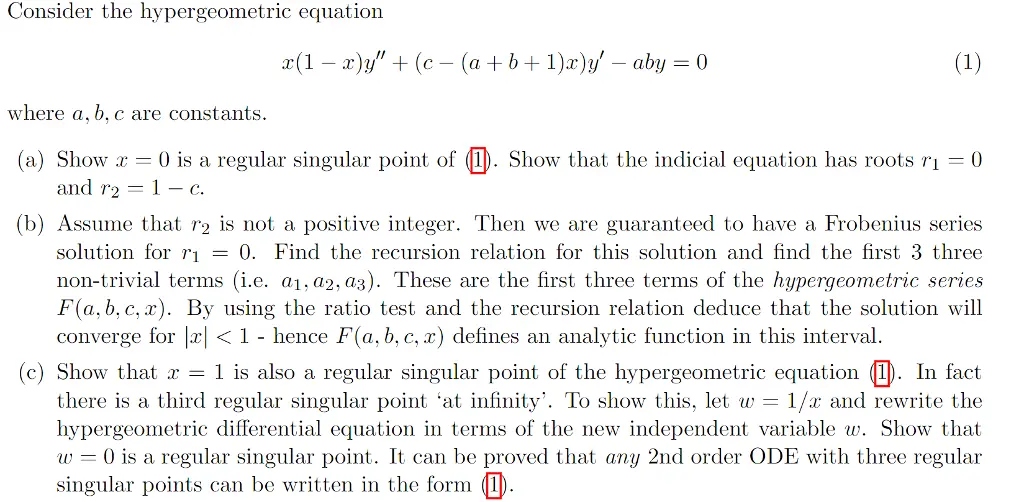
Transcribed Image Text:
Consider the hypergeometric equation
where a, b, c are constants.
x(1-x)y" (c-(a+b+1)x)y' - aby = 0
E
(a) Show x = 0 is a regular singular point of (1. Show that the indicial equation has roots r₁ = 0
and r21 C.
(b) Assume that r2 is not a positive integer. Then we are guaranteed to have a Frobenius series
solution for r₁ = 0. Find the recursion relation for this solution and find the first 3 three
non-trivial terms (i.e. a1, a2, a3). These are the first three terms of the hypergeometric series
F(a, b, c, x). By using the ratio test and the recursion relation deduce that the solution will
converge for a <1 - hence F(a, b, c, x) defines an analytic function in this interval.
(c) Show that x = 1 is also a regular singular point of the hypergeometric equation (1). In fact
there is a third regular singular point ‘at infinity'. To show this, let w = 1/x and rewrite the
hypergeometric differential equation in terms of the new independent variable w. Show that
w = 0 is a regular singular point. It can be proved that any 2nd order ODE with three regular
singular points can be written in the form (1.
check_circle الجواب — حل مفصل خطوة بخطوة
hourglass_top
🔒
الحل الكامل متاح للمشتركين
اشترك في أرشيف الأسئلة لعرض هذا الحل وآلاف الحلول المفصلة خطوة بخطوة من معلمين معتمدين.