تم الحل ✓
categoryفيزياء
schoolبكالوريوس
event_available2026-07-14
السؤال
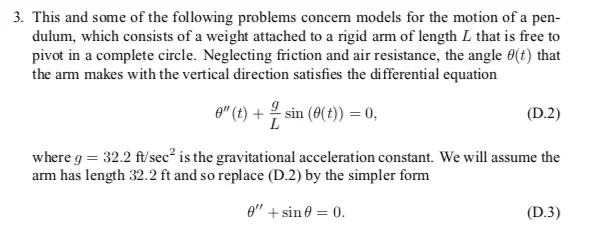
Transcribed Image Text:
3. This and some of the following problems concern models for the motion of a pen-
dulum, which consists of a weight attached to a rigid arm of length L that is free to
pivot in a complete circle. Neglecting friction and air resistance, the angle (t) that
the arm makes with the vertical direction satisfies the differential equation
0" (t) + sin (0(t)) = 0,
(D.2)
where g = 32.2 ft/sec² is the gravitational acceleration constant. We will assume the
arm has length 32.2 ft and so replace (D.2) by the simpler form
0"+sin=0.
(D.3)
(Alternatively, one can rescale time, replacing t by √√g/Lt, to convert (D.2) to
(D.3).) For motions with small displacements (small), sin ≈ 0, and (D.3) can
be approximated by the linear equation
0"+0=0.
(D.4)
This equation has general solution (t) = A cos(t-6), with amplitude A and phase
shift 5. Hence all the solutions to the linear approximation (D.4) have period 2,
independent of the amplitude A. In this problem we consider solutions of equation
(D.3) satisfying the initial conditions (0) = A, '(0) = 0. If |A| <T, these so-
lutions are periodic. However, in contrast to the linear equation (D.4), their periods
depend on the amplitude A. We do expect that, for small displacements A, the solu-
tions to the pendulum (D.3) will have periods close to 2.
(a) Investigate how the period depends on the amplitude A by plotting a numerical
solution of equation (D.3) using initial conditions (0) = A, 0'(0) = 0 on an
appropriate interval for various A. Estimate the periods of the pendulum for
the amplitudes A = 0.1, 0.7, 1.5, and 3.0. Confirm these results by displaying
the displacements at a sequence of times, and finding the time at which the
pendulum returns to its original position.
(b) The period is given by the formula
T=4
/2
do
1- k² sin²
where k = sin(A/2). This formula may be derived in your text; it can be
found in Section 9.3 of Boyce & DiPrima, Problem 29. The integral is called
an elliptic integral. It cannot be evaluated by an elementary formula, but it can
be computed by int in terms of a MuPAD function elliptick, or can be
evaluated numerically using quadl. Calculate the period for the values of A
we are considering. Do the values agree with those obtained in part (a)?
(c) Redo the numerical calculations in part (a) with different tolerances, choosing
the tolerances so that the values you get agree with those calculated in part (b).
(d) How does the period depend on the amplitude of the initial displacement? For
A small, is the period close to 2? What is happening to the accuracy of the
linear approximation as the initial displacement increases?
4. In this problem, we'll look at what the pendulum does for various initial velocities
(cf. Problem 3).
(a) Numerically solve the differential equation (D.3) using initial conditions (0) =
0, '(0) = 1. Solve equation (D.4) with the same initial conditions. Plot on
the same graph the solutions to both the nonlinear equation (D.3) and the linear
equation (D.4) on the interval from t = 0 to t = 40, and compare the two.
Be clear about which curve is the nonlinear solution and which is the linear
solution.
(b) Repeat part (a) and compare the linear and nonlinear solutions for each of the
following values of the initial velocity v: 1, 1.99, 2, 2.01. For the (numerical)
nonlinear solution, interpret what the graph indicates the pendulum is doing
physically. What do you think the exact solution does in each case?
check_circle الجواب — حل مفصل خطوة بخطوة
hourglass_top
🔒
الحل الكامل متاح للمشتركين
اشترك في أرشيف الأسئلة لعرض هذا الحل وآلاف الحلول المفصلة خطوة بخطوة من معلمين معتمدين.