تم الحل ✓
categoryفيزياء
schoolبكالوريوس
event_available2026-07-14
السؤال
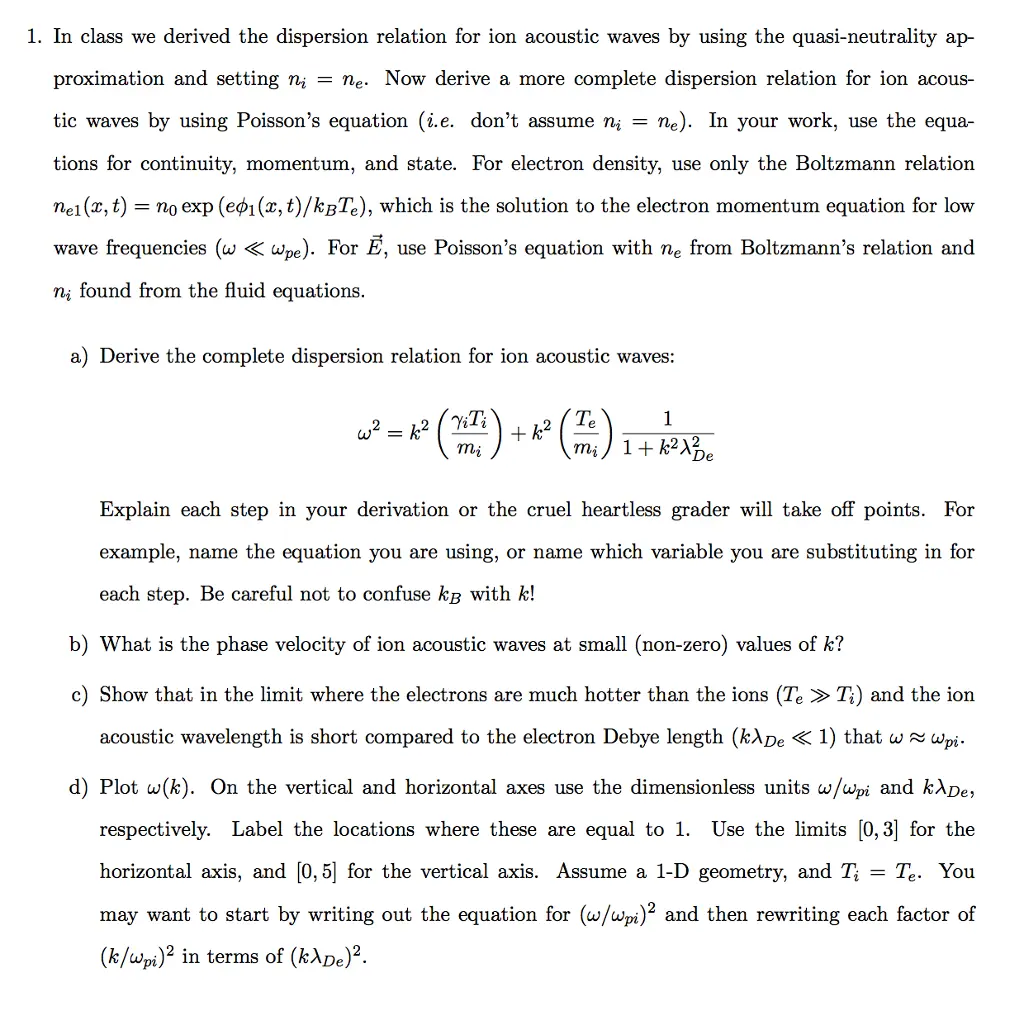
Transcribed Image Text:
1. In class we derived the dispersion relation for ion acoustic waves by using the quasi-neutrality ap-
proximation and setting n = ne. Now derive a more complete dispersion relation for ion acous-
tic waves by using Poisson's equation (i.e. don't assume ni = ne). In your work, use the equa-
tions for continuity, momentum, and state. For electron density, use only the Boltzmann relation
nel (x,t) = no exp (eo₁(x,t)/kBT), which is the solution to the electron momentum equation for low
wave frequencies (w << wpe). For Ē, use Poisson's equation with ne from Boltzmann's relation and
ni found from the fluid equations.
a) Derive the complete dispersion relation for ion acoustic waves:
= k²
YiTi
mi
+k²
1
Te
mi 1+k²X²e
Explain each step in your derivation or the cruel heartless grader will take off points. For
example, name the equation you are using, or name which variable you are substituting in for
each step. Be careful not to confuse kB with k!
b) What is the phase velocity of ion acoustic waves at small (non-zero) values of k?
c) Show that in the limit where the electrons are much hotter than the ions (Te »T₁) and the ion
acoustic wavelength is short compared to the electron Debye length (kλDe << 1) that w≈ wpi.
d) Plot w(k). On the vertical and horizontal axes use the dimensionless units w/wpi and kλDe,
respectively. Label the locations where these are equal to 1. Use the limits [0,3] for the
horizontal axis, and [0,5] for the vertical axis. Assume a 1-D geometry, and T₁ = Te. You
may want to start by writing out the equation for (w/wpi) 2 and then rewriting each factor of
(k/wpi) in terms of (kλDe)².
check_circle الجواب — حل مفصل خطوة بخطوة
hourglass_top
🔒
الحل الكامل متاح للمشتركين
اشترك في أرشيف الأسئلة لعرض هذا الحل وآلاف الحلول المفصلة خطوة بخطوة من معلمين معتمدين.