تم الحل ✓
categoryرياضيات
schoolبكالوريوس
event_available2026-07-14
السؤال
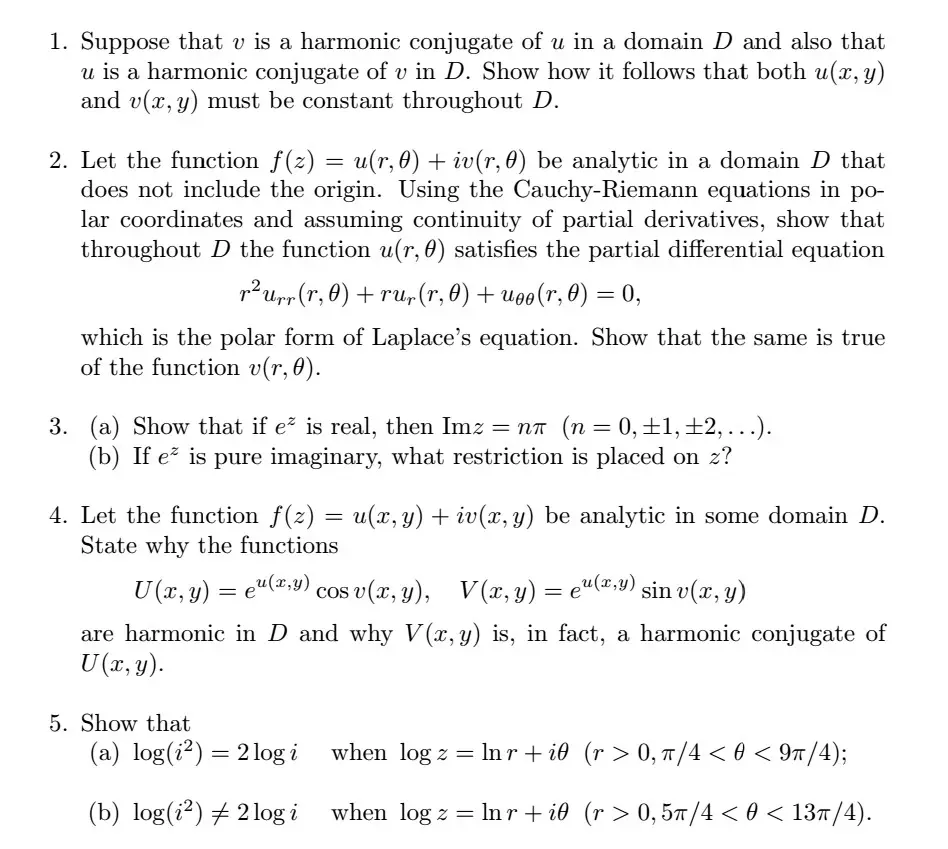
Transcribed Image Text:
1. Suppose that v is a harmonic conjugate of u in a domain D and also that
u is a harmonic conjugate of v in D. Show how it follows that both u(x, y)
and v(x, y) must be constant throughout D.
2. Let the function f(z) = u(r,0) + iv(r, 0) be analytic in a domain D that
does not include the origin. Using the Cauchy-Riemann equations in po-
lar coordinates and assuming continuity of partial derivatives, show that
throughout D the function u(r, 0) satisfies the partial differential equation
r²urr (r, 0) + rur (r, 0) + uoo (r, 0) = 0,
which is the polar form of Laplace's equation. Show that the same is true
of the function v(r, 0).
3. (a) Show that if e² is real, then Imz = në (n= 0, ±1, ±2, . . .).
(b) If ez is pure imaginary, what restriction is placed on z?
4. Let the function f(z) = u(x, y) + iv(x, y) be analytic in some domain D.
State why the functions
U(x, y) = u(x,y) cos v(x, y), V(x,y) = eu(x,y) sin v(x, y)
are harmonic in D and why V(x, y) is, in fact, a harmonic conjugate of
U(x, y).
5. Show that
(a) log(2) = 2log i when log z = lnr+i0 (r> 0,π/4<< 9π/4);
<0
(b) log(2) 2log i when logz = lnr+i0 (r> 0,5π/4 < 0 < 13π/4).
check_circle الجواب — حل مفصل خطوة بخطوة
hourglass_top
🔒
الحل الكامل متاح للمشتركين
اشترك في أرشيف الأسئلة لعرض هذا الحل وآلاف الحلول المفصلة خطوة بخطوة من معلمين معتمدين.