تم الحل ✓
categoryرياضيات
schoolبكالوريوس
event_available2026-07-14
السؤال
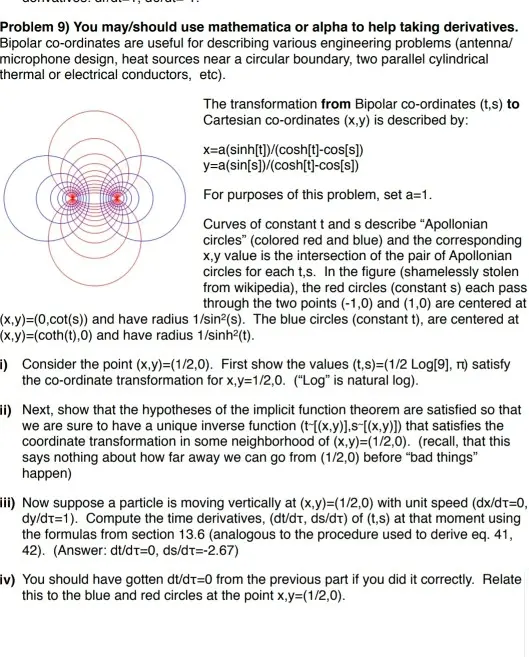
Transcribed Image Text:
Problem 9) You may/should use mathematica or alpha to help taking derivatives.
Bipolar co-ordinates are useful for describing various engineering problems (antenna/
microphone design, heat sources near a circular boundary, two parallel cylindrical
thermal or electrical conductors, etc).
The transformation from Bipolar co-ordinates (t,s) to
Cartesian co-ordinates (x,y) is described by:
x=a(sinh[t])/(cosh[t]-cos[s])
y=a(sin[s])/(cosh[t]-cos[s])
For purposes of this problem, set a=1.
Curves of constant t and s describe "Apollonian
circles" (colored red and blue) and the corresponding
x,y value is the intersection of the pair of Apollonian
circles for each t,s. In the figure (shamelessly stolen
from wikipedia), the red circles (constant s) each pass
through the two points (-1,0) and (1,0) are centered at
(x,y)=(0,cot(s)) and have radius 1/sin2(s). The blue circles (constant t), are centered at
(x,y)=(coth(t),0) and have radius 1/sinh2(t).
i) Consider the point (x,y)=(1/2,0). First show the values (t,s)=(1/2 Log[9], n) satisfy
the co-ordinate transformation for x,y=1/2,0. ("Log" is natural log).
ii) Next, show that the hypotheses of the implicit function theorem are satisfied so that
we are sure to have a unique inverse function (t-[(x,y)],s-[(x,y)]) that satisfies the
coordinate transformation in some neighborhood of (x,y)=(1/2,0). (recall, that this
says nothing about how far away we can go from (1/2,0) before "bad things"
happen)
iii) Now suppose a particle is moving vertically at (x,y)=(1/2,0) with unit speed (dx/dt=0,
dy/dt=1). Compute the time derivatives, (dt/dτ, ds/dT) of (t,s) at that moment using
the formulas from section 13.6 (analogous to the procedure used to derive eq. 41,
42). (Answer: dt/dτ=0, ds/dτ=-2.67)
iv) You should have gotten dt/dt=0 from the previous part if you did it correctly. Relate
this to the blue and red circles at the point x,y=(1/2,0).
check_circle الجواب — حل مفصل خطوة بخطوة
hourglass_top
🔒
الحل الكامل متاح للمشتركين
اشترك في أرشيف الأسئلة لعرض هذا الحل وآلاف الحلول المفصلة خطوة بخطوة من معلمين معتمدين.