تم الحل ✓
categoryفيزياء
schoolبكالوريوس
event_available2026-07-13
السؤال
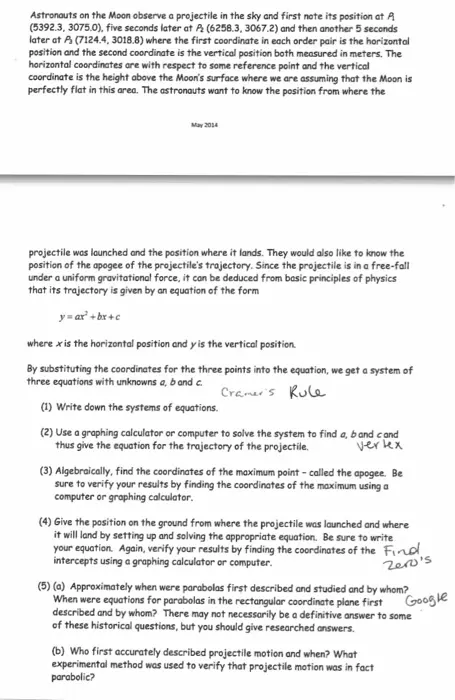
Transcribed Image Text:
Astronauts on the Moon observe a projectile in the sky and first note its position at A
(5392.3, 3075.0), five seconds later at A (6258.3, 3067.2) and then another 5 seconds
later at A (7124.4, 3018.8) where the first coordinate in each order pair is the horizontal
position and the second coordinate is the vertical position both measured in meters. The
horizontal coordinates are with respect to some reference point and the vertical
coordinate is the height above the Moon's surface where we are assuming that the Moon is
perfectly flat in this area. The astronauts want to know the position from where the
May 2014
projectile was launched and the position where it lands. They would also like to know the
position of the apogee of the projectile's trajectory. Since the projectile is in a free-fall
under a uniform gravitational force, it can be deduced from basic principles of physics
that its trajectory is given by an equation of the form
y=ax² + bx + c
where x is the horizontal position and y is the vertical position.
By substituting the coordinates for the three points into the equation, we get a system of
three equations with unknowns a, b and c
(1) Write down the systems of equations.
Cramer's Rule
(2) Use a graphing calculator or computer to solve the system to find a, b and cand
thus give the equation for the trajectory of the projectile. Vertex
(3) Algebraically, find the coordinates of the maximum point - called the apogee. Be
sure to verify your results by finding the coordinates of the maximum using a
computer or graphing calculator.
(4) Give the position on the ground from where the projectile was launched and where
it will land by setting up and solving the appropriate equation. Be sure to write
your equation. Again, verify your results by finding the coordinates of the Find
intercepts using a graphing calculator or computer.
Zero's
Google
(5) (a) Approximately when were parabolas first described and studied and by whom?
When were equations for parabolas in the rectangular coordinate plane first
described and by whom? There may not necessarily be a definitive answer to some
of these historical questions, but you should give researched answers.
(b) Who first accurately described projectile motion and when? What
experimental method was used to verify that projectile motion was in fact
parabolic?
check_circle الجواب — حل مفصل خطوة بخطوة
hourglass_top
🔒
الحل الكامل متاح للمشتركين
اشترك في أرشيف الأسئلة لعرض هذا الحل وآلاف الحلول المفصلة خطوة بخطوة من معلمين معتمدين.