تم الحل ✓
categoryهندسة كهربائية
schoolبكالوريوس
event_available2026-07-14
السؤال
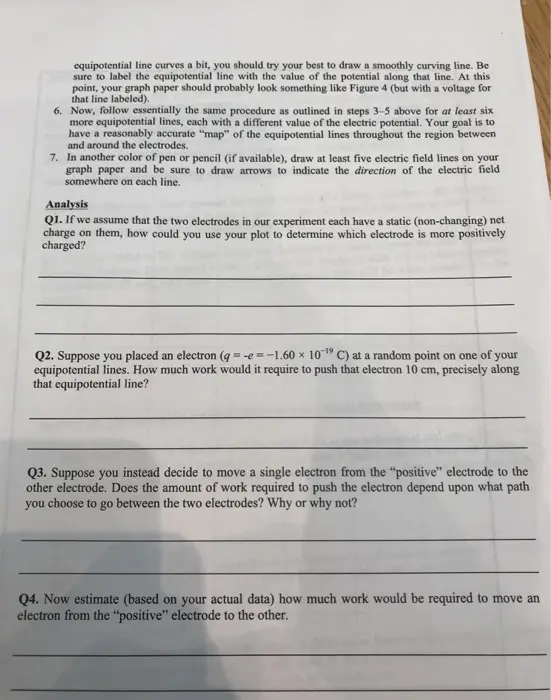
Transcribed Image Text:
equipotential line curves a bit, you should try your best to draw a smoothly curving line. Be
sure to label the equipotential line with the value of the potential along that line. At this
point, your graph paper should probably look something like Figure 4 (but with a voltage for
that line labeled).
6. Now, follow essentially the same procedure as outlined in steps 3-5 above for at least six
more equipotential lines, each with a different value of the electric potential. Your goal is to
have a reasonably accurate "map" of the equipotential lines throughout the region between
and around the electrodes.
7. In another color of pen or pencil (if available), draw at least five electric field lines on your
graph paper and be sure to draw arrows to indicate the direction of the electric field
somewhere on each line.
Analysis
Q1. If we assume that the two electrodes in our experiment each have a static (non-changing) net
charge on them, how could you use your plot to determine which electrode is more positively
charged?
Q2. Suppose you placed an electron (qe=-1.60 x 10⁹ C) at a random point on one of your
equipotential lines. How much work would it require to push that electron 10 cm, precisely along
that equipotential line?
Q3. Suppose you instead decide to move a single electron from the "positive" electrode to the
other electrode. Does the amount of work required to push the electron depend upon what path
you choose to go between the two electrodes? Why or why not?
Q4. Now estimate (based on your actual data) how much work would be required to move an
electron from the "positive" electrode to the other.
check_circle الجواب — حل مفصل خطوة بخطوة
hourglass_top
🔒
الحل الكامل متاح للمشتركين
اشترك في أرشيف الأسئلة لعرض هذا الحل وآلاف الحلول المفصلة خطوة بخطوة من معلمين معتمدين.