تم الحل ✓
categoryهندسة ميكانيكية
schoolبكالوريوس
event_available2026-07-14
السؤال
Transcribed Image Text:
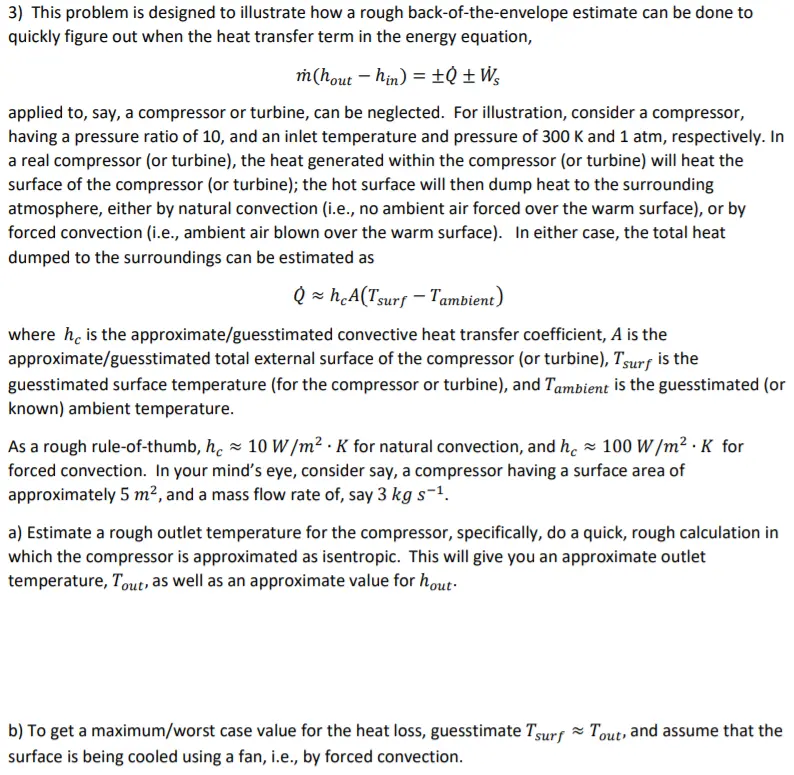
3) This problem is designed to illustrate how a rough back-of-the-envelope estimate can be done to
quickly figure out when the heat transfer term in the energy equation,
m(hout hin) +Q + Ws
=
applied to, say, a compressor or turbine, can be neglected. For illustration, consider a compressor,
having a pressure ratio of 10, and an inlet temperature and pressure of 300 K and 1 atm, respectively. In
a real compressor (or turbine), the heat generated within the compressor (or turbine) will heat the
surface of the compressor (or turbine); the hot surface will then dump heat to the surrounding
atmosphere, either by natural convection (i.e., no ambient air forced over the warm surface), or by
forced convection (i.e., ambient air blown over the warm surface). In either case, the total heat
dumped to the surroundings can be estimated as
QhA(Tsurf - Tambient)
where he is the approximate/guesstimated convective heat transfer coefficient, A is the
approximate/guesstimated total external surface of the compressor (or turbine), Tsurf is the
guesstimated surface temperature (for the compressor or turbine), and Tambient is the guesstimated (or
known) ambient temperature.
As a rough rule-of-thumb, he 10 W/m² K for natural convection, and he 100 W/m². K for
forced convection. In your mind's eye, consider say, a compressor having a surface area of
approximately 5 m², and a mass flow rate of, say 3 kg s−1.
a) Estimate a rough outlet temperature for the compressor, specifically, do a quick, rough calculation in
which the compressor is approximated as isentropic. This will give you an approximate outlet
temperature, Tout, as well as an approximate value for hout
≈2
b) To get a maximum/worst case value for the heat loss, guesstimate Tsurf Tout, and assume that the
surface is being cooled using a fan, i.e., by forced convection.
check_circle الجواب — حل مفصل خطوة بخطوة
hourglass_top
🔒
الحل الكامل متاح للمشتركين
اشترك في أرشيف الأسئلة لعرض هذا الحل وآلاف الحلول المفصلة خطوة بخطوة من معلمين معتمدين.