تم الحل ✓
categoryرياضيات
schoolبكالوريوس
event_available2026-07-14
السؤال
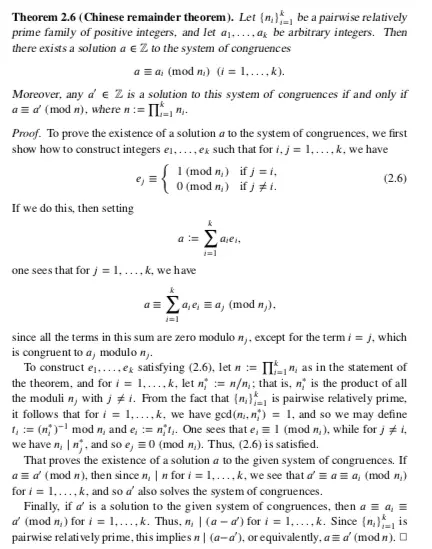
Transcribed Image Text:
Theorem 2.6 (Chinese remainder theorem). Let (n.), be a pairwise relatively
prime family of positive integers, and let a.....ak be arbitrary integers. Then
there exists a solution a € Z to the system of congruences
a = a, (mod n) (i = 1,...,k).
Moreover, any de Z is a solution to this system of congruences if and only if
a=d' (mod n), where n := [In
Proof. To prove the existence of a solution a to the system of congruences, we first
show how to construct integers e..... ex such that for i, j = 1,..... k, we have
= {
1 (mod n,) if j=i.
If we do this, then setting
a=
- Σ
aje.
i=]
(2.6)
one sees that for j = 1,..., k, we have
a=
Σa,e,a, (mod n,).
since all the terms in this sum are zero modulo n,, except for the term i = j, which
is congruent to a, modulo nj.
To construct ej..... ek satisfying (2.6), let n = II, as in the statement of
the theorem, and for i = 1,...,k, let n = n/n,; that is, n is the product of all
the moduli n, with ji. From the fact that (n,) is pairwise relatively prime.
it follows that for i = 1,....k, we have gcd (m, n) = 1, and so we may define
nt. One sees that e,
0 (mod n,). Thus, (2.6) is satisfied.
1, (n) mod n, and e,
we have n, n, and so e,
1 (mod n,), while for j i.
That proves the existence of a solution a to the given system of congruences. If
a=d' (mod n), then since n, | n for i = 1,..., k, we see that d² = a = a, (mod n,)
for i=1,....k, and so d' also solves the system of congruences.
Finally, if d' is a solution to the given system of congruences, then a = a, =
d' (mod n,) for i = 1,...,k. Thus, n, | (a-d) for i = 1,.... k. Since (n,) is
pairwise relatively prime, this implies n | (a-d'), or equivalently, ad' (modn).
check_circle الجواب — حل مفصل خطوة بخطوة
hourglass_top
🔒
الحل الكامل متاح للمشتركين
اشترك في أرشيف الأسئلة لعرض هذا الحل وآلاف الحلول المفصلة خطوة بخطوة من معلمين معتمدين.