تم الحل ✓
categoryهندسة كهربائية
schoolبكالوريوس
event_available2026-07-14
السؤال
Transcribed Image Text:
3.
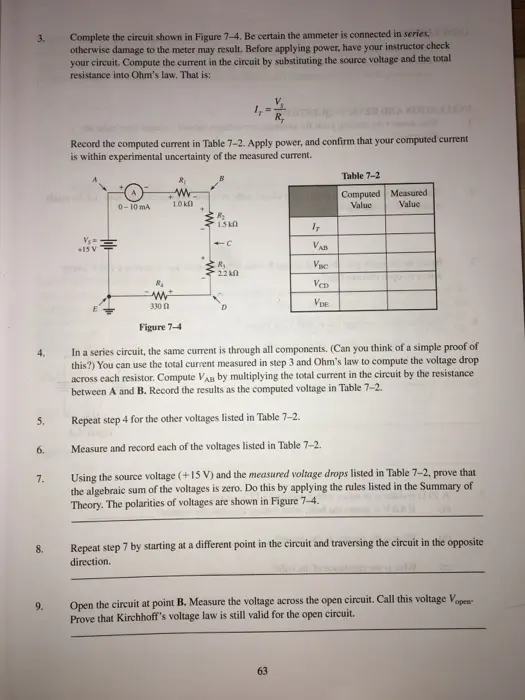
Complete the circuit shown in Figure 7-4. Be certain the ammeter is connected in series, S
otherwise damage to the meter may result. Before applying power, have your instructor check
your circuit. Compute the current in the circuit by substituting the source voltage and the total
resistance into Ohm's law. That is:
GRA PORTAFAVR
Record the computed current in Table 7-2. Apply power, and confirm that your computed current
is within experimental uncertainty of the measured current.
V=
+15 V
Table 7-2
100
0-10mA
Value
Computed Measured
Value
R:
15k0
IT
-C
VAB
Ry
Vac
2.2k
VCD
ww
VDE
4.
3300
Figure 7-4
In a series circuit, the same current is through all components. (Can you think of a simple proof of
this?) You can use the total current measured in step 3 and Ohm's law to compute the voltage drop
across each resistor. Compute VAB by multiplying the total current in the circuit by the resistance
between A and B. Record the results as the computed voltage in Table 7-2.
5.
Repeat step 4 for the other voltages listed in Table 7-2.
6.
Measure and record each of the voltages listed in Table 7-2.
7.
8.
Using the source voltage (+15 V) and the measured voltage drops listed in Table 7-2, prove that
the algebraic sum of the voltages is zero. Do this by applying the rules listed in the Summary of
Theory. The polarities of voltages are shown in Figure 7-4.
001 A
Repeat step 7 by starting at a different point in the circuit and traversing the circuit in the opposite
direction.
9.
Open the circuit at point B. Measure the voltage across the open circuit. Call this voltage Vopen-
Prove that Kirchhoff's voltage law is still valid for the open circuit.
63
2.
3.
4.
CONCLUSION
EVALUATION AND REVIEW QUESTIONS
1.
Why doesn't the starting point for summing the voltages around a closed loop make any
difference?
Kirchhoff's voltage law applies to any closed path, even one without current. How did the readh
of step 9 show that this is true?
Based on the result you observed in step 9, what voltage would you expect in a 120 V circuit
across an open (blown) fuse?
Use Kirchhoff's voltage law to find Vy in Figure 7-5:
5.
A 10
(a)
resistor is in series with a bulb and a 12 V source.
If 8.0 V is across the bulb, what voltage is across the resistor?
(b)
What is the current in the circuit?
(c)
What is the resistance of the bulb?
+9 V
+2V-
V₁ =?
w
Figure 7-5
check_circle الجواب — حل مفصل خطوة بخطوة
hourglass_top
🔒
الحل الكامل متاح للمشتركين
اشترك في أرشيف الأسئلة لعرض هذا الحل وآلاف الحلول المفصلة خطوة بخطوة من معلمين معتمدين.