تم الحل ✓
categoryهندسة ميكانيكية
schoolبكالوريوس
event_available2026-07-13
السؤال
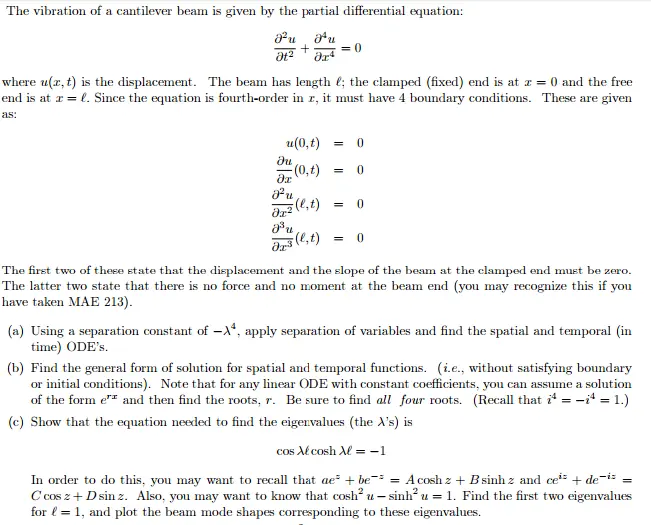
Transcribed Image Text:
The vibration of a cantilever beam is given by the partial differential equation:
J²u Ju
+ = 0
at2
where u(x,t) is the displacement. The beam has length e; the clamped (fixed) end is at x = 0 and the free
end is at x = l. Since the equation is fourth-order in r, it must have 4 boundary conditions. These are given
as:
u(0,t)
== 0
Ju
(0,t) =
0
მე:
J²u
მე-2
(l,t)
==
0
J³u
(lt)
=
0
The first two of these state that the displacement and the slope of the beam at the clamped end must be zero.
The latter two state that there is no force and no moment at the beam end (you may recognize this if you
have taken MAE 213).
(a) Using a separation constant of -14, apply separation of variables and find the spatial and temporal (in
time) ODE's.
(b) Find the general form of solution for spatial and temporal functions. (i.e., without satisfying boundary
or initial conditions). Note that for any linear ODE with constant coefficients, you can assume a solution
of the form er and then find the roots, r. Be sure to find all four roots. (Recall that 44 = 1.)
(c) Show that the equation needed to find the eigenvalues (the A's) is
cos Alcosh Al-1
In order to do this, you may want to recall that ae + be = A cosh z + B sinh z and ce¹³ + de-i
C cos z + D sin z. Also, you may want to know that cosh² u-sinh² u = 1. Find the first two eigenvalues
for 1, and plot the beam mode shapes corresponding to these eigenvalues.
Tu(x,t)
l
check_circle الجواب — حل مفصل خطوة بخطوة
hourglass_top
🔒
الحل الكامل متاح للمشتركين
اشترك في أرشيف الأسئلة لعرض هذا الحل وآلاف الحلول المفصلة خطوة بخطوة من معلمين معتمدين.