تم الحل ✓
categoryهندسة مواد
schoolبكالوريوس
event_available2026-07-14
السؤال
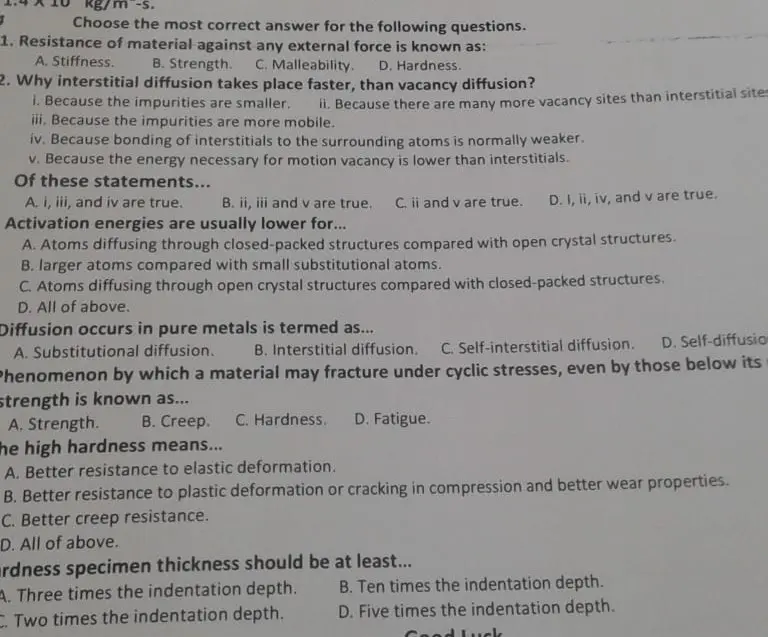
Transcribed Image Text:
-S.
Choose the most correct answer for the following questions.
1. Resistance of material against any external force is known as:
A. Stiffness. B. Strength. C. Malleability. D. Hardness.
2. Why interstitial diffusion takes place faster, than vacancy diffusion?
i. Because the impurities are smaller.
ii. Because there are many more vacancy sites than interstitial sites
iii. Because the impurities are more mobile.
iv. Because bonding of interstitials to the surrounding atoms is normally weaker.
v. Because the energy necessary for motion vacancy is lower than interstitials.
Of these statements...
A. i, iii, and iv are true. B. ii, iii and v are true. C. ii and v are true.
Activation energies are usually lower for...
D. I, ii, iv, and v are true.
A. Atoms diffusing through closed-packed structures compared with open crystal structures.
B. larger atoms compared with small substitutional atoms.
C. Atoms diffusing through open crystal structures compared with closed-packed structures.
D. All of above.
Diffusion occurs in pure metals is termed as...
A. Substitutional diffusion. B. Interstitial diffusion. C. Self-interstitial diffusion.
D. Self-diffusion
Phenomenon by which a material may fracture under cyclic stresses, even by those below its
strength is known as...
A. Strength.
B. Creep.
C. Hardness. D. Fatigue.
The high hardness means...
A. Better resistance to elastic deformation.
B. Better resistance to plastic deformation or cracking in compression and better wear properties.
C. Better creep resistance.
D. All of above.
rdness specimen thickness should be at least...
A. Three times the indentation depth.
C. Two times the indentation depth.
B. Ten times the indentation depth.
D. Five times the indentation depth.
Q.4
1.4 X 10 kg/m²-s.
Choose the most correct answer for the following questions.
1. Resistance of material against any external force is known as:
A. Stiffness.
B. Strength.
C. Malleability.
D. Hardness.
2. Why interstitial diffusion takes place faster, than vacancy diffusion?
i. Because the impurities are smaller.
ii. Because there are many more vacancy sites than in
iii. Because the impurities are more mobile.
iv. Because bonding of interstitials to the surrounding atoms is normally weaker.
v. Because the energy necessary for motion vacancy is lower than interstitials.
Of these statements...
A. i, iii, and iv are true.
B. ii, iii and v are true.
C. ii and v are true.
D. I, ii, iv, and var
3. Activation energies are usually lower for...
A. Atoms diffusing through closed-packed structures compared with open crystal structure
B. larger atoms compared with small substitutional atoms.
C. Atoms diffusing through open crystal structures compared with closed-packed structures.
D. All of above.
4. Diffusion occurs in pure metals is termed as...
A. Substitutional diffusion.
B. Interstitial diffusion.
C. Self-interstitial diffusion.
5. Phenomenon by which a material may fracture under cyclic stresses, even by the
strength is known as...
A. Strength. B. Creep.
C. Hardness.
D. Fatigue.
6. The high hardness means...
A. Better resistance to elastic deformation.
B. Better resistance to plastic deformation or cracking in compression and better wear
C. Better creep resistance.
D. All of above.
7. Hardness specimen thickness should be at least...
A. Three times the indentation depth.
C. Two times the indentation depth.
B. Ten times the indentation depth.
D. Five times the indentation depth.
Good Luck
Dr. Rasheed Amerah.
check_circle الجواب — حل مفصل خطوة بخطوة
hourglass_top
🔒
الحل الكامل متاح للمشتركين
اشترك في أرشيف الأسئلة لعرض هذا الحل وآلاف الحلول المفصلة خطوة بخطوة من معلمين معتمدين.