تم الحل ✓
categoryهندسة ميكانيكية
schoolبكالوريوس
event_available2026-07-14
السؤال
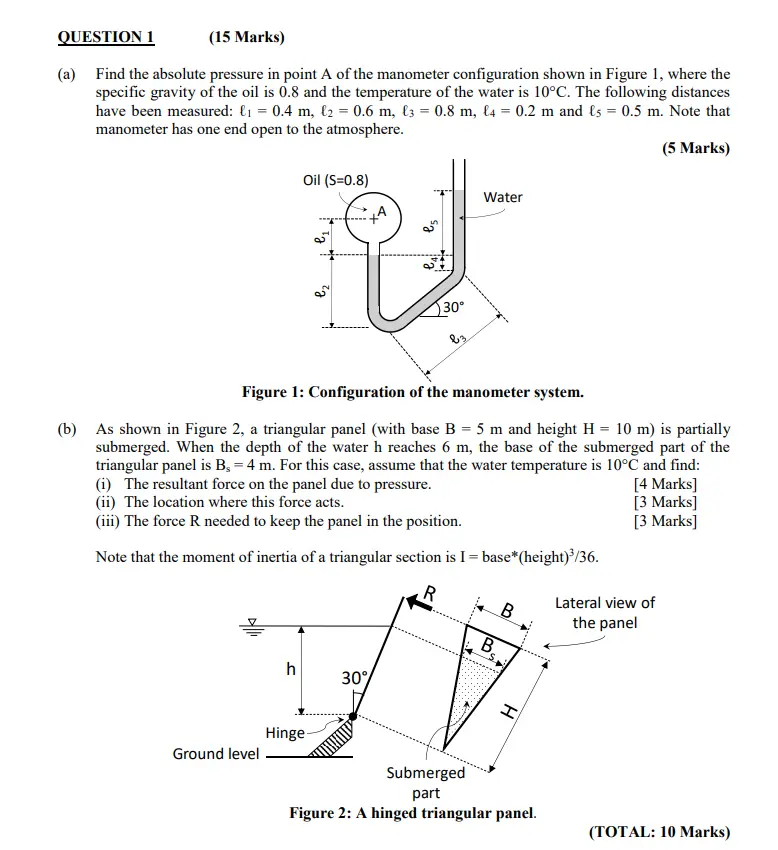
Transcribed Image Text:
QUESTION 1
(15 Marks)
(a) Find the absolute pressure in point A of the manometer configuration shown in Figure 1, where the
specific gravity of the oil is 0.8 and the temperature of the water is 10°C. The following distances
have been measured: ₁ = 0.4 m, l2 = 0.6 m, l3 = 0.8 m, 4 = 0.2 m and ls = 0.5 m. Note that
manometer has one end open to the atmosphere.
Oil (S=0.8)
(5 Marks)
+A
Water
30°
b3
Note that the moment of inertia of a triangular section is I = base* (height)³/36.
Figure 1: Configuration of the manometer system.
(b) As shown in Figure 2, a triangular panel (with base B = 5 m and height H = 10 m) is partially
submerged. When the depth of the water h reaches 6 m, the base of the submerged part of the
triangular panel is B₁ = 4 m. For this case, assume that the water temperature is 10°C and find:
(i) The resultant force on the panel due to pressure.
(ii) The location where this force acts.
(iii) The force R needed to keep the panel in the position.
[4 Marks]
[3 Marks]
[3 Marks]
Lateral view of
B
the panel
B
h
30%
Hinge
Ground level
H
Submerged
part
Figure 2: A hinged triangular panel.
(TOTAL: 10 Marks)
QUESTION 2
(16 Marks)
(a) Oxygen (p = 1.429 kg/m³) and methane (p = 1.82 kg/m³) are mixed in a container, as shown in
Figure 3. Given that the flow of oxygen is Q₁ = 0.5 m³/s and the flow of methane is Q2 = 1.2 m³/s,
find the mass flow rate exiting the container.
(3 Marks)
(b)
Q1(Oxygen)
Q2(Methane)
Container
Q3(Mix)
Figure 3: A filling tank.
Figure 4 shows a frontal section of a junction that connects three pipes. The junction shape is a cube
of side L= 0.3 m and mass 0.5 kg. The junction connects three pipes that carry water at 60°C. Given
the properties in Table 1, where some partial results are computed, find:
(i) The flow Q3
[1 Marks]
[4 Marks]
(ii) Neglecting losses and elevation difference, find the pressure in pipe 3
(iii) Find the x and z components of the reaction force required to keep the junction in place.
Flange
Junction
Q₂
Q1
Z
Q3
30°
Figure 4: Frontal section of the connection.
Table 1: information available
[8 Marks]
Data
Pipe 1
Pipe 2
Pipe 3
Flow (m³/s)
1.00
0.6
?
Diameter (m)
0.80
0.70
0.40
Area (m²)
0.50
0.38
0.13
Velocity (m/s)
1.99
1.56
?
Pressure (kPa)
200
200.8
?
TOTAL (13 marks)
QUESTION 3
(12 Marks)
(a) NASA is asking you to help preparing a plan to colonise the planet Mars. Given that Mars'
atmosphere does not have enough oxygen to sustain human life, pumps will need to pump air from
a filtration centre to the colony through pipelines. NASA is asking you to test a small model (scale
1:500) on Earth, assuming that the air used in the pipelines on Mars will have the same composition
of the air as on Earth, but the pressure and temperature of the air on Mars will be 600 Pa abs and -
20°C, respectively, while, on Earth, you will be testing air at 20°C and at atmospheric pressure. If
the air velocity in the pipelines on Mars is supposed 5 m/s, at which velocity should you test the
model on Earth? Assume the change in pressure will not affect the air viscosity.
(6 Marks)
(b) During the packaging process, warm honey (assume v=0.00115 m²/s) flows by gravity through a
vertical smooth pipe (D = 10 cm, L = 2 m). The end of the pipeline is open to the atmosphere while
the initial part is connected to the bottom of a storage tank, where the honey level is maintained 1 m
above the bottom.
(i) Sketch the system
[1 Mark]
(ii) Compute the velocity of the honey in the pipe. Neglect minor losses. If you need to do iterations
to solve this question, start from an initial value of f=0.2 and compute two iterations.
QUESTION 4
(20 Marks)
[5 Marks]
(TOTAL 6 Marks)
(a) A hydro-electric plant whose layout is shown in Figure 5 needs to discharge a flow Q = 2 m³/s.
Assume the water temperature is 10°C and neglect minor losses:
(i) Compute the turbine head if the
length of the pipeline is L=1000
m, the diameter D = 1 m and the
pipe material is ductile iron
cement lined (DICL) pipe
(roughness height & = 0.35 mm).
Assume that the diameter at the
discharge side of the turbine is
the same as the diameter of the
pipeline. State all other
assumptions that you make.
[5 Marks]
(ii) If the turbine efficiency is 90%,
what is the power produced?
[2 Marks]
H = 35m
Penstock
Turbine and
generator
Figure 5: Layout of the system
(TOTAL 7 marks)
QUESTION 4 (CONTINUED)
(b) The system shown in Figure 6 delivers water from a lower storage (the bottom of the storage is at
an elevation z₁ = 20 m) to an upper storage (the bottom of the storage is at an elevation z2 = 75 m).
Note that a pump, a half-open gate valve and two 45° elbows are present in the system. The pipeline
is made of cast iron (e = 0.26 mm) and has a total length of 5000 m.
(i) List all the minor losses and the related minor loss coefficients.
[1 Marks]
(ii) Sketch the energy and the hydraulic grade lines in the system (considering minor losses). The
sketch is not expected to be to scale. An approximate schematic is acceptable (i.e. do not
compute numerical values).
[5 Marks]
(iii) Assume fully rough turbulent flow in the pipe and neglect all of the minor losses: compute the
minimum pipe diameter required to deliver a flow of 0.5 m³/s if the pump head hp = 85 m. If
you need to do iterations, start from a value of f-0.02 and compute 2 iterations.
[5 Marks]
(iv) For the diameter found in (iii), compute the total value of the minor losses. If you did not solve
point (iii), consider a diameter equal to 0.5 m.
[2
Marks]
H₁ = 1 m
QUESTION 5
(21 Marks)
Half open
gate valve
Pump
45° Elbow
H₁₂ = 5
Figure 6: Layout of the system.
(TOTAL: 13 Marks)
(a) The concrete channel shown in Figure 7 (Manning's value
n=0.015) has a slope of 0.005.
(i) If the water depth y is 0.5 m, what is the discharge?
1
(ii) What is the Froude number?
[4 Marks]
[3 Marks]
(TOTAL 7 Marks)
1
Figure 7: Section of the triangular
channel
y
QUESTION 5
(CONTINUED)
(b) A flow Q-20 m³/s flows at a water depth y=2 m in a rectangular channel with width B=10 m.
(i)
Find the critical depth of the flow
(ii) Find if the flow is subcritical or supercritical. Give a brief explanation.
[2 Marks]
[2 Marks]
(iii) If the bottom of the channel rises by 3 m (see Figure 8), find the water depths before and on the
upstep.
[7 Marks]
Y₂?
Q
У1?
AZ=3m
Figure 8: Longitudinal section of the channel.
(TOTAL: 11 Marks)
(c) In a rectangular channel, the water depth after a hydraulic jump is y = 4 m. What is the conjugate
depth if the flow per unit of width in the channel is 6 m²/s?
QUESTION 6
(16 Marks)
(3 Marks)
A triangular channel has a section similar to the one in Figure 7. The channel can be divided in three
sections of different slopes as shown in Figure 9.
(i)
(ii)
Classify the flow profiles knowing that the critical depth is ye=1.83 m, the normal depths are
ynl=0.75 m and yn3 = 1.24 m for sections 1 and 3, respectively, and that a hydraulic jump occurs
in section 1.
[6 Marks]
Use 2 steps of the direct step method to compute at which distance from the rise in terrain the
flow will reach the uniform flow in section 3. Section 3 has a slope of 0.05 and a Manning's
coefficient equal to 0.015. The flow in the channel is 10 m³/s.
[10 Marks]
(1)
(2)
(TOTAL: 16 Marks)
Rise in
terrain
Figure 9: Layout of the system.
(3)
check_circle الجواب — حل مفصل خطوة بخطوة
hourglass_top
🔒
الحل الكامل متاح للمشتركين
اشترك في أرشيف الأسئلة لعرض هذا الحل وآلاف الحلول المفصلة خطوة بخطوة من معلمين معتمدين.