تم الحل ✓
categoryاقتصاد عام
schoolبكالوريوس
event_available2026-07-13
السؤال
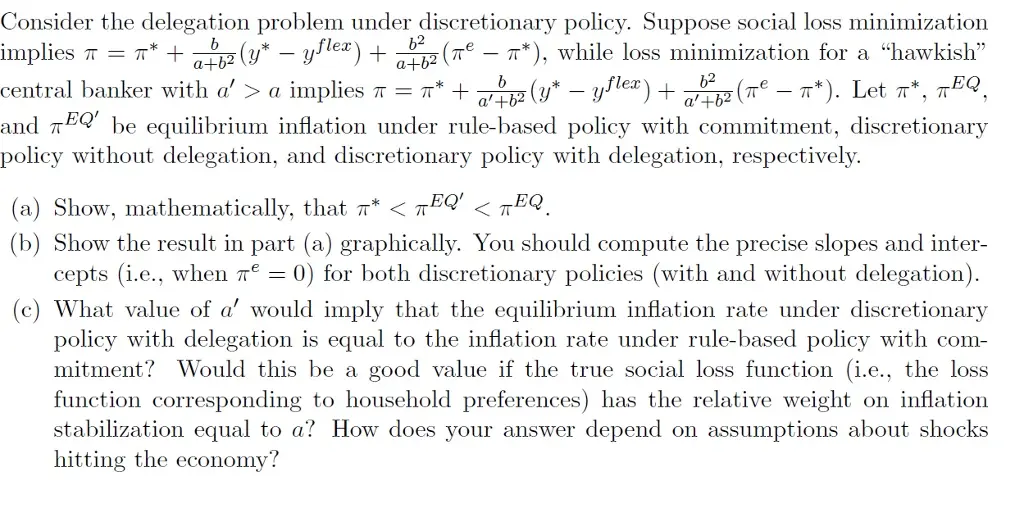
Transcribed Image Text:
Consider the delegation problem under discretionary policy. Suppose social loss minimization
implies π = * ++b² (y* — yflex) +
*), while loss minimization for a "hawkish"
62
a+b2
-
a'+62
-
-
central banker with a' > a implies π = π* + 01+b² (y* − yflex) + a1b2ô²(ú – ñ*). Let ñ*, êQ,
and EQ' be equilibrium inflation under rule-based policy with commitment, discretionary
policy without delegation, and discretionary policy with delegation, respectively.
(a) Show, mathematically, that * < πEQ' < EQ.
(b) Show the result in part (a) graphically. You should compute the precise slopes and inter-
cepts (i.e., when Te = 0) for both discretionary policies (with and without delegation).
(c) What value of a' would imply that the equilibrium inflation rate under discretionary
policy with delegation is equal to the inflation rate under rule-based policy with com-
mitment? Would this be a good value if the true social loss function (i.e., the loss
function corresponding to household preferences) has the relative weight on inflation
stabilization equal to a? How does your answer depend on assumptions about shocks
hitting the economy?
check_circle الجواب — حل مفصل خطوة بخطوة
hourglass_top
🔒
الحل الكامل متاح للمشتركين
اشترك في أرشيف الأسئلة لعرض هذا الحل وآلاف الحلول المفصلة خطوة بخطوة من معلمين معتمدين.