تم الحل ✓
categoryرياضيات
schoolبكالوريوس
event_available2026-07-13
السؤال
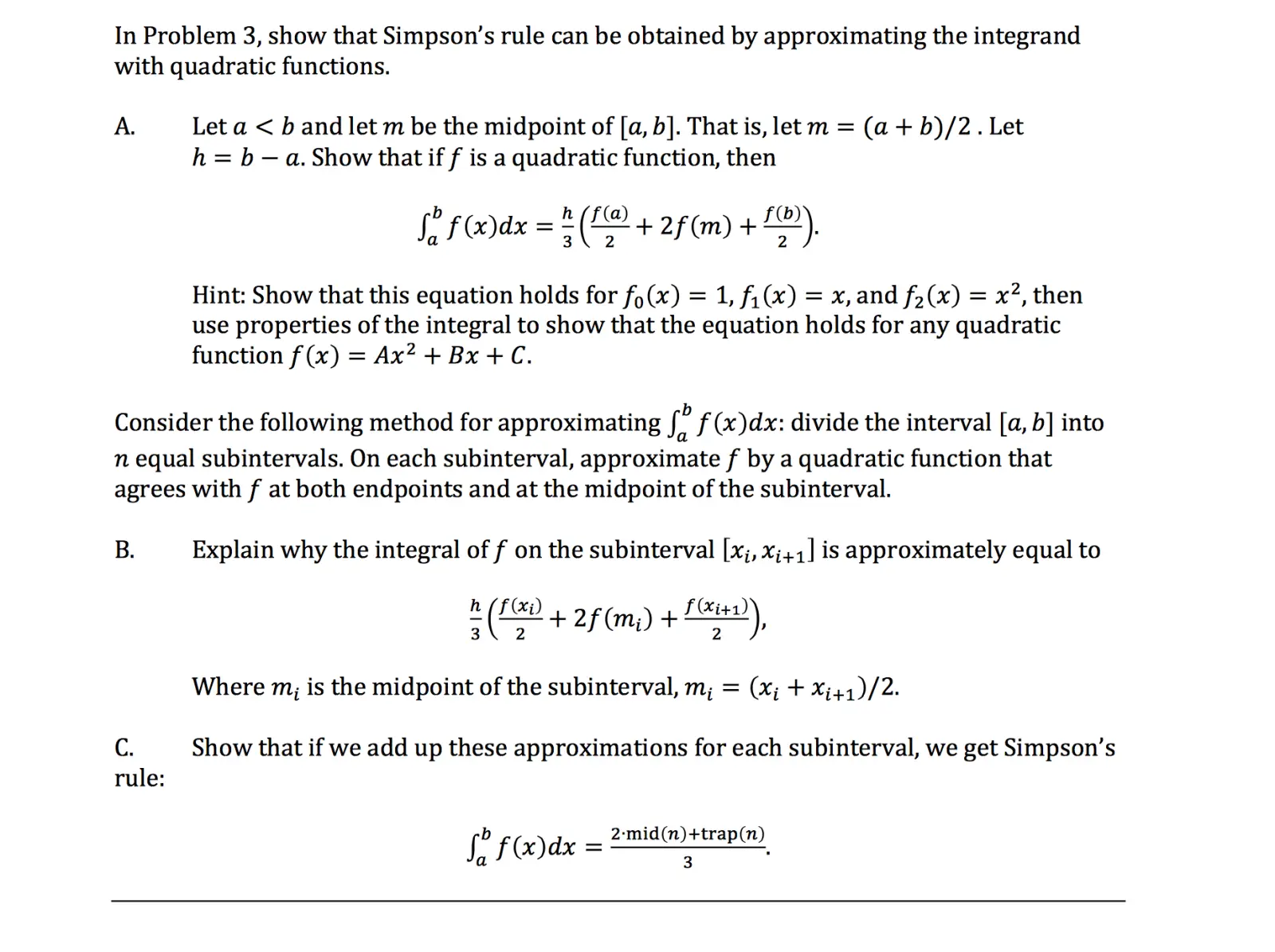
Transcribed Image Text:
In Problem 3, show that Simpson's rule can be obtained by approximating the integrand
with quadratic functions.
A.
Let a <b and let m be the midpoint of [a, b]. That is, let m =
h = ba. Show that if f is a quadratic function, then
(a + b)/2. Let
h
fo f (x)dx = 1½ (f(a) + 2f (m) + f(b)).
3
2
Hint: Show that this equation holds for fo (x) = 1, f₁(x) : = x, and f₂(x) = x², then
use properties of the integral to show that the equation holds for any quadratic
function f(x) = Ax² + Bx + C.
Consider the following method for approximating for f (x)dx: divide the interval [a, b] into
n equal subintervals. On each subinterval, approximate ƒ by a quadratic function that
agrees with fat both endpoints and at the midpoint of the subinterval.
B.
Explain why the integral off on the subinterval [xi, xi+1] is approximately equal to
h
3
2
1½ (F(x) + 2 ƒ (m²) + f (x + 1)),
2
C.
rule:
Where mĘ is the midpoint of the subinterval, m₁ = (xi + Xi+1)/2.
Show that if we add up these approximations for each subinterval, we get Simpson's
Så f(x)dx
2.mid(n)+trap(n)
=
3
check_circle الجواب — حل مفصل خطوة بخطوة
hourglass_top
🔒
الحل الكامل متاح للمشتركين
اشترك في أرشيف الأسئلة لعرض هذا الحل وآلاف الحلول المفصلة خطوة بخطوة من معلمين معتمدين.