تم الحل ✓
categoryهندسة مدنية
schoolبكالوريوس
event_available2026-07-13
السؤال
Transcribed Image Text:
Parallel-Axis Theorem for an Area
Learning Goal:
To be able to use the parallel-axis theorem to calculate the moment of inertia for an area.
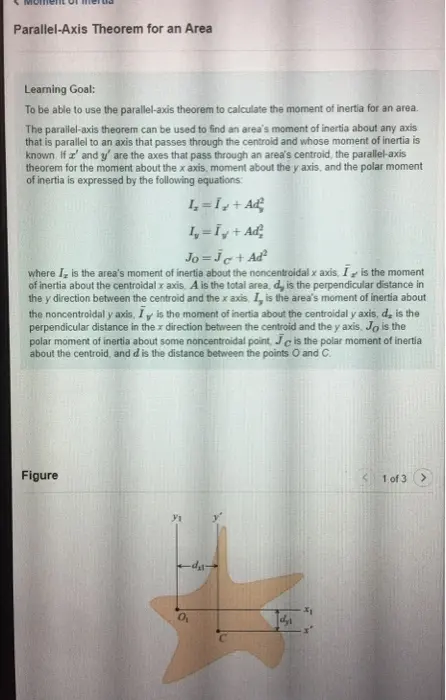
The parallel-axis theorem can be used to find an area's moment of inertia about any axis
that is parallel to an axis that passes through the centroid and whose moment of inertia is
known. If z' and y' are the axes that pass through an area's centroid, the parallel-axis
theorem for the moment about the x axis, moment about the y axis, and the polar moment
of inertia is expressed by the following equations:
1=1, + Ad
I₁ = I + Ad
Jo=Jc + Ad²
where I, is the area's moment of inertia about the noncentroidal x axis. I, is the moment
of inertia about the centroidal x axis. A is the total area, d, is the perpendicular distance in
the y direction between the centroid and the x axis. I, is the area's moment of inertia about
the noncentroidal y axis, Iy is the moment of inertia about the centroidal y axis, d₂ is the
perpendicular distance in the x direction between the centroid and the y axis, Jo is the
polar moment of inertia about some noncentroidal point. Je is the polar moment of inertia
about the centroid, and d is the distance between the points O and C.
Figure
-d-
31
1 of 3
>
y
b
+1
134
↑
0
h
KA
C
0
<
3 of
Part B
As shown, a rectangle has a base of b 9.10 ft and a height of h = 4.60 ft. (Figure 2) The rectangle's bottom is located at a distance y₁ = 3.00 ft
from the x axis, and the rectangle's left edge is located at a distance ₁ =3.00 ft from the y axis. What are I, and I,, the area's moments of inertia,
about the x and y axes, respectively?
Express your answers numerically in biquadratic feet (feet to the fourth power) to three significant figures separated by a comma.
▸ View Available Hint(s)
I.. Iy=
Submit
ΜΕ ΑΣΦ 11 vec
?
ft4
Part C
The semicircle shown (Figure 3) has a moment of inertia about the x axis of 70.0 ft and a moment of inertia about the y axis of 70.0 ft. What is the
polar moment of inertia about point C (the centroid)?
Express your answer numerically in biquadratic feet (feet to the fourth power) to three significant figures.
▸ View Available Hint(s)
Jc=
ΜΕ ΑΣΦ 11 vec
ft4
9:37 PM
check_circle الجواب — حل مفصل خطوة بخطوة
hourglass_top
🔒
الحل الكامل متاح للمشتركين
اشترك في أرشيف الأسئلة لعرض هذا الحل وآلاف الحلول المفصلة خطوة بخطوة من معلمين معتمدين.