تم الحل ✓
categoryهندسة ميكانيكية
schoolبكالوريوس
event_available2026-07-13
السؤال
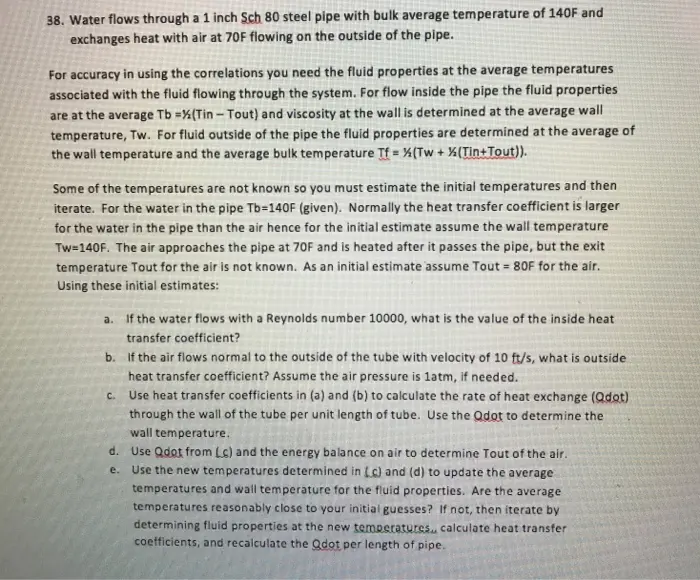
Transcribed Image Text:
38. Water flows through a 1 inch Sch 80 steel pipe with bulk average temperature of 140F and
exchanges heat with air at 70F flowing on the outside of the pipe.
For accuracy in using the correlations you need the fluid properties at the average temperatures
associated with the fluid flowing through the system. For flow inside the pipe the fluid properties
are at the average Tb X(Tin-Tout) and viscosity at the wall is determined at the average wall
temperature, Tw. For fluid outside of the pipe the fluid properties are determined at the average of
the wall temperature and the average bulk temperature Tf = (Tw+%(Tin+Tout)).
Some of the temperatures are not known so you must estimate the initial temperatures and then
iterate. For the water in the pipe Tb-140F (given). Normally the heat transfer coefficient is larger
for the water in the pipe than the air hence for the initial estimate assume the wall temperature
Tw=140F. The air approaches the pipe at 70F and is heated after it passes the pipe, but the exit
temperature Tout for the air is not known. As an initial estimate assume Tout = 80F for the air.
Using these initial estimates:
a. If the water flows with a Reynolds number 10000, what is the value of the inside heat
transfer coefficient?
b. If the air flows normal to the outside of the tube with velocity of 10 ft/s, what is outside
heat transfer coefficient? Assume the air pressure is 1atm, if needed.
C. Use heat transfer coefficients in (a) and (b) to calculate the rate of heat exchange (Qdot)
through the wall of the tube per unit length of tube. Use the Qdot to determine the
wall temperature.
d. Use Qdot from Lc) and the energy balance on air to determine Tout of the air.
e. Use the new temperatures determined in (c) and (d) to update the average
temperatures and wall temperature for the fluid properties. Are the average
temperatures reasonably close to your initial guesses? If not, then iterate by
determining fluid properties at the new temperatures calculate heat transfer
coefficients, and recalculate the Qdot per length of pipe.
check_circle الجواب — حل مفصل خطوة بخطوة
hourglass_top
🔒
الحل الكامل متاح للمشتركين
اشترك في أرشيف الأسئلة لعرض هذا الحل وآلاف الحلول المفصلة خطوة بخطوة من معلمين معتمدين.