تم الحل ✓
categoryهندسة طبية وبيومكترونيك
schoolبكالوريوس
event_available2026-07-13
السؤال
Transcribed Image Text:
B Differential Equations in Clinical Medicine
Courtesy of Philip Crooke, Vanderbilt University
In medicine, mechanical ventilation is a procedure that assists or replaces spontaneous breath-
ing for critically ill patients, using a medical device called a ventilator. Some people attribute the
first mechanical ventilation to Andreas Vesalius in 1555. Negative pressure ventilators (iron
lungs) came into use in the 1940s-1950s in response to poliomyelitis (polio) epidemics. Philip
Drinker and Louis Shaw are credited with its invention. Modern ventilators use positive pressure
to inflate the lungs of the patient. In the ICU (intensive care unit), common indications for the ini-
tiation of mechanical ventilation are acute respiratory failure, acute exacerbation of chronic
obstructive pulmonary disease, coma, and neuromuscular disorders. The goals of mechanical
ventilation are to provide oxygen to the lungs and to remove carbon dioxide.
In this project, we model the mechanical process performed by the ventilator. We make the
following assumptions about this process of filling the lungs with air and then letting them deflate
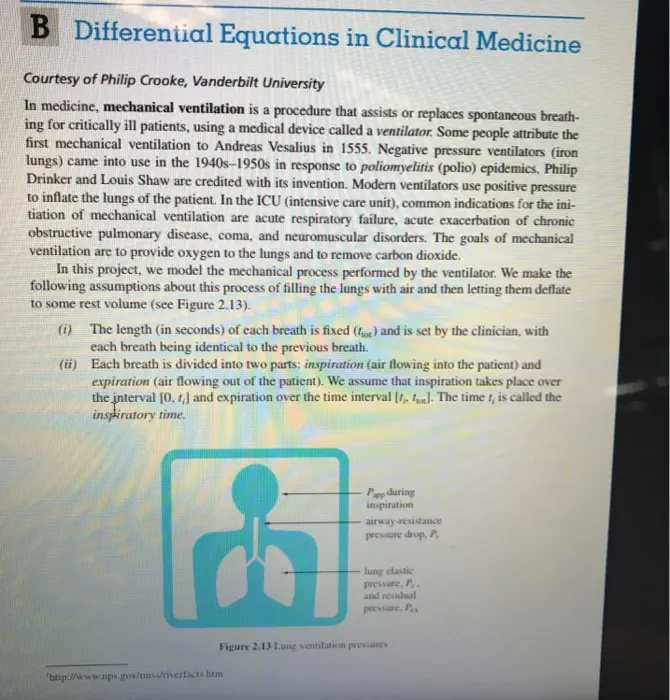
to some rest volume (see Figure 2.13).
(i) The length (in seconds) of each breath is fixed (for) and is set by the clinician, with
each breath being identical to the previous breath.
(ii) Each breath is divided into two parts: inspiration (air flowing into the patient) and
expiration (air flowing out of the patient). We assume that inspiration takes place over
the interval [0, 1] and expiration over the time interval [4]. The time t, is called the
inspiratory time.
http://www.nps.gov/miss/riverfacts.htm
Papp during
inspiration
airway-resistance
pressure drop, P
lung clastic
pressure, P.
and residual
pressure, Pes
Figure 2.13 Lung ventilation pressures
(iii) During inspiration the ventilator applies a constant pressure Papp to the patient's air-
way, and during expiration this pressure is zero, relative to atmospheric pressure. This
is called pressure-controlled ventilation.
(iv) We assume that the pulmonary system (lung) is modeled by a single compartment.
Hence, the action of the ventilator is similar to inflating a balloon and then releasing
the pressure.
(v)
At the airway there is a pressure balance:
(1)
P,+P+ Pex Paw
where P, denotes pressure losses due to resistance to flow into and out of the lung, P, is
the elastic pressure due to changes in volume of the lung. Pex is a residual pressure that
remains in the lung at the completion of a breath, and Paw denotes the pressure applied to
the airway. (Paw Papp during inspiration and Paw 0 during expiration.) The residual
pressure Pex is called the end-expiratory pressure.
=
(vi) Let V(t) denote the volume of the lung at time 1, with V, (r), 0 ≤1st, denoting its
volume during inspiration and V,(1), 1, SIS or its volume during expiration. We
assume that V,(0) = V (t) = 0. The number V,(t) = V is called the tidal volume of
the breath.
(vii) We assume that the resistive pressure P, is proportional to the flows into and out of the
lung such that P R(dVIdr), and we assume that the proportionality constant R is
the same for inspiration and expiration.
(viii) Furthermore, we assume that the elastic pressure is proportional to the instantaneous
volume of the lung. That is, Pe (1/C)V, where the constant C is called the compliance
of the lung.
Using the pressure equation in (1) together with the above assumptions, a mathematical
model for the instantaneous volume in the single compartment lung is given by the following pair
of first-order linear differential equations:
of first-order linear differential equations:
(2)
R(dv) + (2) V + Pa =
Papp 051≤1.
(3)
Ve+Pex = 0, SI≤ hot
The initial conditions, as indicated in assumption (vi), are V,(0) = 0 and V,(t) = V(t) = Vr.
The constant Pex is not known a priori but is determined from the end condition on the expiratory
volume: V(t) = 0. This will make each breath identical to the previous breath. To obtain a for-
mula for Pex, complete the following steps.
(a) Solve equation (2) for V,(r) with the initial condition V,(0) = 0.
(b) Solve equation (3) for V, (r) with the initial condition V,(t) = Vr.
(e) Using the fact that V,(r) =V7, show that
Pex
(RC-1) Papp
RC-1
(d) For R-10 cm (H₂O)/L/sec, C = 0.02 Lcm (H₂O). Papp -20 cm (H₂O), 1 - 1 sec and
fot 3 sec, plot the graphs of V,(r) and V,(r) over the interval [0, fol. Compute P for
ex
these parameters.
(e) The mean alveolar pressure is the average pressure in the lung during inspiration and is
given by the formula
Pm
=
(V) dt
dt + Pex:
Compute this quantity using your expression for V,(t) in part (a).
check_circle الجواب — حل مفصل خطوة بخطوة
hourglass_top
🔒
الحل الكامل متاح للمشتركين
اشترك في أرشيف الأسئلة لعرض هذا الحل وآلاف الحلول المفصلة خطوة بخطوة من معلمين معتمدين.