تم الحل ✓
categoryرياضيات
schoolبكالوريوس
event_available2026-07-13
السؤال
Transcribed Image Text:
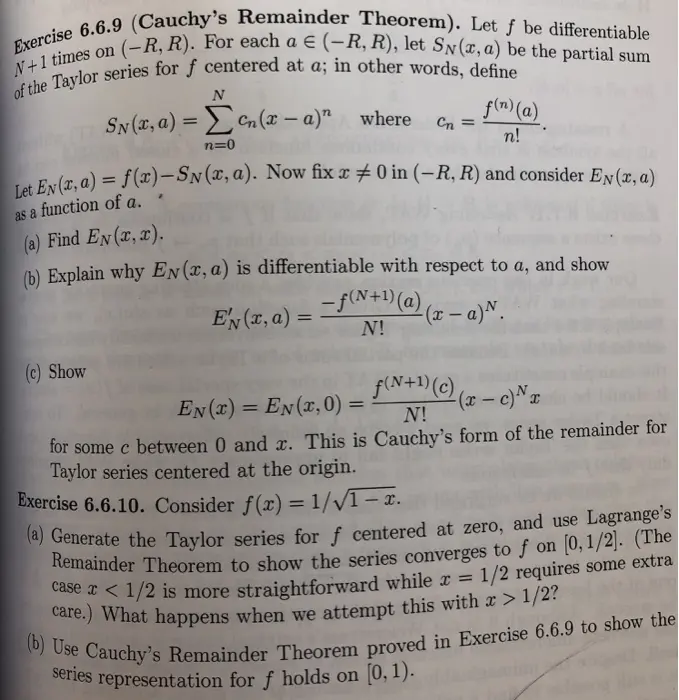
Exercise 6.6.9 (Cauchy's Remainder Theorem). Let f be differentiable
N+1 times on (-R, R). For each a € (-R, R), let SN(x, a) be the partial sum
of the Taylor series for f centered at a; in other words, define
N
SN (x, a) = c(x-a)" where Cn=
n=0
f(n) (a)
n!
Let Ex(x, a) = f(x)-SN(x, a). Now fix x 0 in (-R, R) and consider EN(x, a)
as a function of a.
(a) Find EN (x, x).
(b) Explain why EN (x, a) is differentiable with respect to a, and show
(c) Show
-f(N+1)(a)
E' (x, a) =
(x - a)N.
N!
EN(x)=EN(x, 0):
==
TAƒ(N+1) (c) (x
(x- c) x
N!
for some c between 0 and x. This is Cauchy's form of the remainder for
Taylor series centered at the origin.
Exercise 6.6.10. Consider f(x) = 1/√√1-x.
(a) Generate the Taylor series for f centered at zero, and use Lagrange's
Remainder Theorem to show the series converges to fƒ on [0, 1/2]. (The
case x < 1/2 is more straightforward while x =
care.) What happens when we attempt this with x > 1/2?
1/2 requires some extra
(b) Use Cauchy's Remainder Theorem proved in Exercise 6.6.9 to show the
series representation for f holds on [0, 1).
check_circle الجواب — حل مفصل خطوة بخطوة
hourglass_top
🔒
الحل الكامل متاح للمشتركين
اشترك في أرشيف الأسئلة لعرض هذا الحل وآلاف الحلول المفصلة خطوة بخطوة من معلمين معتمدين.