تم الحل ✓
categoryهندسة ميكانيكية
schoolبكالوريوس
event_available2026-07-13
السؤال
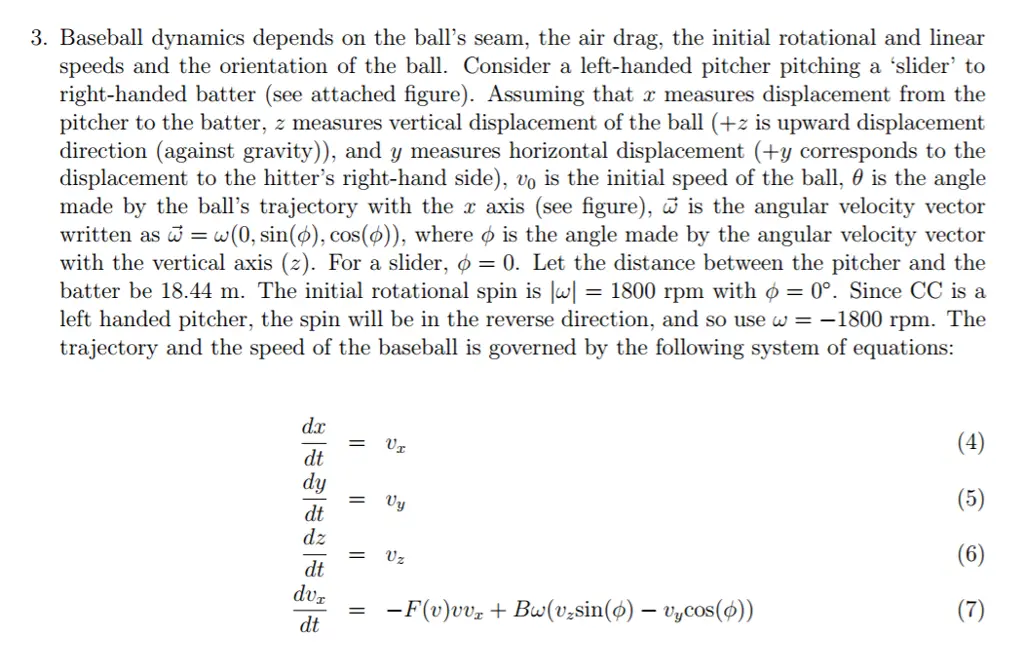
Transcribed Image Text:
3. Baseball dynamics depends on the ball's seam, the air drag, the initial rotational and linear
speeds and the orientation of the ball. Consider a left-handed pitcher pitching a 'slider' to
right-handed batter (see attached figure). Assuming that x measures displacement from the
pitcher to the batter, z measures vertical displacement of the ball (+z is upward displacement
direction (against gravity)), and y measures horizontal displacement (+y corresponds to the
displacement to the hitter's right-hand side), vo is the initial speed of the ball, is the angle
made by the ball's trajectory with the x axis (see figure), is the angular velocity vector
written as = w(0, sin(), cos(0)), where is the angle made by the angular velocity vector
with the vertical axis (2). For a slider, = 0. Let the distance between the pitcher and the
batter be 18.44 m. The initial rotational spin is w| = 1800 rpm with = 0°. Since CC is a
left handed pitcher, the spin will be in the reverse direction, and so use w = -1800 rpm. The
trajectory and the speed of the baseball is governed by the following system of equations:
dt
dy
=
dx
=
Ux
|||L|
Vy
dt
dz
dt
dvi
dt
=
=
Vz
-F(v)vvr + Bw(v2sin(o) - vycos(0))
(5)
4500
(4)
(6)
(7)
N
13
4feet
slider
18.44 m
Pitching mound
Batter
= -F(v)vvy + Bwvzcos(ó)
(8)
dv.
=-g-F(v)vv, + Bwv,sin(o)
dt
(9)
where v₂, ty, and v₂ are the velocity components in the r, y, and z directions, respectively.
Also, v corresponds to the speed of the ball v = √√+v+vg = 9.81 is the gravitational
acceleration, and F(v) is the drag force experienced by the baseball which is given as,
0.0058
F(x)=0.0039 +
1+ exp[(v-35)/5]
(10)
in SI units. B in the above expression results from a force called Magnus Force, a force
due to rotation of the ball in a shearing flow that causes the ball to curve during its forward
flight. Use B = 4.1 x 10⁴ (note that B is dimensionless quantity).
Let the following be the initial conditions for the above system of equations:
x(t = 0) = 0
y(t = 0) = 0
z(t = 0) = 0
vy(t = 0) = 0
v(t = 0) = cos(6)
v₂(t = 0) = vosin (0),
(11)
(12)
(13)
(14)
(15)
(16)
where v = 85 mph is the initial speed, and 0 = 1°.
(a) Using Forward Euler discretization scheme, obtain a finite difference approximation for
each of the equations. Because of the non-linear equations, it is not necessary and
not recommended to write this in matrix-vector form.
(b) Solve above system of differential equations (i.e. write a program that will solve the
above equations using Forward Euler) and obtain solution up to a time at which the
ball crosses the batter (i.e. travels a total distance of 18.44 m. Be careful with the unit
conversions (convert all quantities to SI units). What is the time required for the ball to
cross the batter in seconds? What is the speed of the ball (in miles per hour) when it
just crosses the batter? Choose At = 1 x 10 s.
(c) Plot z (i.e. vertical displacement of the ball) against r (r on x-axis). On the same plot
(and using different line style) plot y (i.e. horizontal displacement of the ball) against
1. Clearly label your plots. [For plotting purposes, convert r, y and z in feet
rather than meters.] What is the net vertical displacement of the ball (note positive
displacement is vertically upwards) as it crosses the batter? What is the net horizontal
displacement of the ball as it crosses the batter?
check_circle الجواب — حل مفصل خطوة بخطوة
hourglass_top
🔒
الحل الكامل متاح للمشتركين
اشترك في أرشيف الأسئلة لعرض هذا الحل وآلاف الحلول المفصلة خطوة بخطوة من معلمين معتمدين.