تم الحل ✓
categoryرياضيات
schoolبكالوريوس
event_available2026-07-13
السؤال
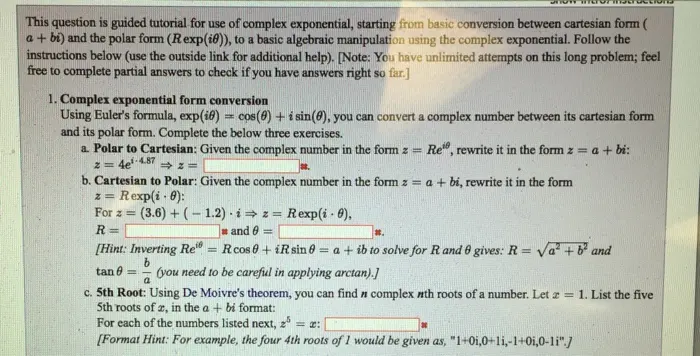
Transcribed Image Text:
This question is guided tutorial for use of complex exponential, starting from basic conversion between cartesian form (
a + bi) and the polar form (R exp(i)), to a basic algebraic manipulation using the complex exponential. Follow the
instructions below (use the outside link for additional help). [Note: You have unlimited attempts on this long problem; feel
free to complete partial answers to check if you have answers right so far.]
1. Complex exponential form conversion
Using Euler's formula, exp(i6) = cos(6) + i sin(6), you can convert a complex number between its cartesian form
and its polar form. Complete the below three exercises.
a. Polar to Cartesian: Given the complex number in the form z = Re, rewrite it in the form z = a + bi:
2 = 4e¹-4.87
==<
b. Cartesian to Polar: Given the complex number in the form z = a + bi, rewrite it in the form
z = Rexp(i-0):
For = (3.6)+(-1.2) iz Rexp(i 6),
R=
=
and 0 =
[Hint: Inverting Re Rcos+iR sina + ib to solve for R and 6 gives: R= √√a² + b² and
tane =
b
(you need to be careful in applying arctan).]
c. 5th Root: Using De Moivre's theorem, you can find n complex nth roots of a number. Let z = 1. List the five
5th roots of 2, in the a + bi format:
For each of the numbers listed next, z
=
[Format Hint: For example, the four 4th roots of I would be given as, "1+01,0+11,-1+0,0-li"./
2. Algebraic manipulation example
In this next set of exercises, we are going to prove a useful statement in two ways: first by using the real-valued trigonometric
functions, and next by using the complex-exponential representation of the same trigonometric functions. This exercise will serve
to show the close relationship between complex exponential functions and trigonometric functions.
Following is a true general statement regarding periodic oscillations: A periodic oscillation at angular frequency w can be
represented in general by f(t) = A cos(wt +), where A represents the amplitude and represents the phase factor. This same
periodic oscillation can be represented by f(t) = B cos(wt) + C sin(wt) for an appropriately chosen constants B and C. In other
words,
f(t) A cos(wt+6)=B cos(wt) + Csin(wt)
=
and we will come up with formulas for B and C in terms of A and and prove this statement in the next set of exercises, starting
with the first method using real-valued trigonometric functions.
a. First method: The strategy here is to expand out the left-hand side (A cos(wt + )) using the angle addition formula. Using
one of the angle addition formulas, expand out the left-hand side and fill in the blanks below (watch out for signs).
A cos(wt+6)=A(D
[Format Hint: (1) Use "*"
Preview cos(wt) +
Preview ).
-",and "/" for multiplication, addition, subtraction, and division. (2) Spell out Greek letters
(e.g. "omega" for w). (3) Use the usual name for functions ("sin", "cos", "tan", etc.).]
b. For this equality to hold for all time t, the coefficients to the cos(wt) terms on left- and right-hand sides should be equal to
each other, and the coefficients to the sin(wt) terms on left- and right-hand sides should be equal to each other. We call this
"collecting like terms" or "comparing like terms" (remember the phrase "like terms" from algebra?). Fill in the blanks below
by comparing like terms:
B=
C =
# Preview and
# Preview
c. Now we can wrap up this derivation. From above result, you have B and C ("Cartesian coordinates," of a sort) as a function
of A and ("Polar coordinates," of a sort). By inverting this relationship, you can express A and o in terms of B and C. Fill
in the blanks below:
A=
tan()=
Preview
and
"
Preview
+
[Format Hint: Use the printable symbols you would use on a calculator (e.g. "A" for exponent, "sqrt(" for taking square root,
etc.).]
d. Second method: You are going to do the same calculations as above, but using the complex representation. The f(t) above
can be represented as
f(t)
=
A exp(iwt +) Bexp(iwt) + Cexp(ilwt -π/2))
The tilde in (t) indicates that the function is complex, with the expectation, Re((t)) -
= f(t). The second term has been
rewritten, using the identity sin(0) = cos(0/2). Using exponential algebra, we can expand out the left-hand side.
Expand out the left-hand side and fill in the blank below:
A exp(iwt + ])=
Preview exp(iwt).
[Format Hint: Use the standard names and symbols (e.g. "exp(x)" for e", and "i" for imaginary number, √-I).]
e. We can do a similar expansion on the right-hand side, factor out a common factor of e, and cancel it from both sides. Fill
in the blanks below the simplified result of your algebraic manipulation. Note: in order to get graded as correct, simplify any
constant complex numbers you can simplify. For example, if you get e", you would write it out as -1 in the simplified
expression.
Ae
"
Preview
What you have shown above is, in the complex representation, you can write (t) = A exp(ilwt + ]) as f (t) = exp(iwt),
where A is the complex amplitude, containing two pieces of information about the oscillatory function, its amplitude (in the
traditional sense referring to the size of oscillation) and its phase. You can choose to express à in the polar form (as A = Ae) or
in the cartesian form (as you have done in the last question above); either way, they are one and the same complex number (the
sense which is lost in the real-valued trigonometric function representation).
check_circle الجواب — حل مفصل خطوة بخطوة
hourglass_top
🔒
الحل الكامل متاح للمشتركين
اشترك في أرشيف الأسئلة لعرض هذا الحل وآلاف الحلول المفصلة خطوة بخطوة من معلمين معتمدين.