تم الحل ✓
categoryفيزياء
schoolبكالوريوس
event_available2026-07-13
السؤال
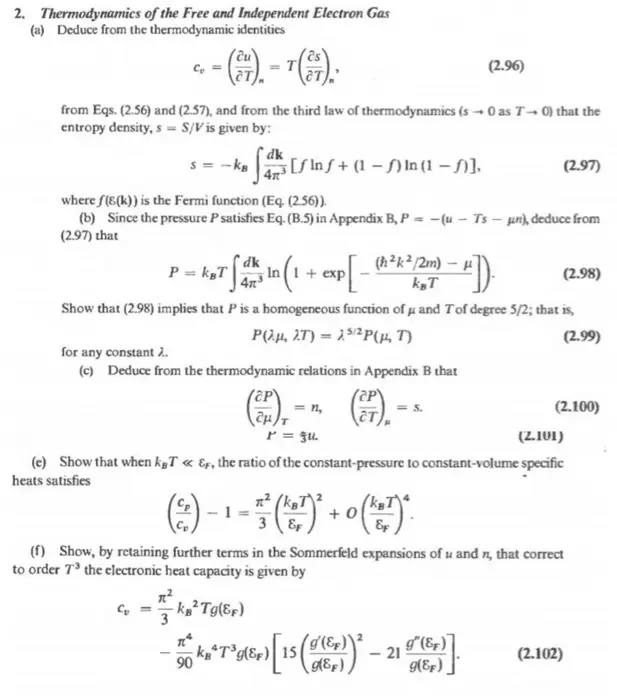
Transcribed Image Text:
2. Thermodynamics of the Free and Independent Electron Gas
(a) Deduce from the thermodynamic identities
− (è). – π (²²).
(2.96)
from Eqs. (2.56) and (2.57), and from the third law of thermodynamics (s 0 as T→ 0) that the
entropy density, s S/V is given by:
dk
-ks Inf+ (1 - ) In (1-)],
where f(&(k)) is the Fermi function (Eq. (2.56)).
(2.97)
(b) Since the pressure P satisfies Eq. (B.5) in Appendix B, P=-(u - Ts - μn), deduce from
(2.97) that
dk
P = k T √ In (1 + exp[-h
4s in
(h2k2/2m)-H
KBT
(2.98)
Show that (2.98) implies that P is a homogeneous function of μ and Tof degree 5/2; that is,
for any constant 2.
P(T) = 25/2P(H, T)
(c) Deduce from the thermodynamic relations in Appendix B that
(2.99)
(on),
= n,
P = zu
= S.
(2.100)
(2.101)
(e) Show that when kgT << &, the ratio of the constant-pressure to constant-volume specific
heats satisfies
1 =
+0
(f) Show, by retaining further terms in the Sommerfeld expansions of u and n, that correct
to order 73 the electronic heat capacity is given by
C₁ =
-kB²Tg(&F)
kT³g(8)
90
'g'(Ep)
A+ d) [15 (8))" - 21 (1)
g"(&F)
9(&F)
(2.102)
We have introduced the Fermi function f(E) to emphasize that f, depends on k only
through the electronic energy &(k):
1
f(ε) =
e-H)/kBT +1
(2.56)
If we divide both sides of (2.55) by the volume V, then (2.29) permits us to write the
energy density u = U/V as
dk
11 =
4π3
ε(k)f(&(k)).
(2.57)
check_circle الجواب — حل مفصل خطوة بخطوة
hourglass_top
🔒
الحل الكامل متاح للمشتركين
اشترك في أرشيف الأسئلة لعرض هذا الحل وآلاف الحلول المفصلة خطوة بخطوة من معلمين معتمدين.