تم الحل ✓
categoryإدارة أعمال
schoolبكالوريوس
event_available2026-07-13
السؤال
Transcribed Image Text:
Case Study
Southwestern University Traffic Problems
Southwestern University (SWU), located in the small town of
Stephenville, Texas, is experiencing increased interest in its
football program now that a big-name coach has been hired.
The increase in season ticket sales for the upcoming season
means additional revenues, but it also means increased com-
plaints due to the traffic problems associated with the football
games. When a new stadium is built, this will only get worse.
Marty Starr, SWU's president, has asked the University Plan-
ning Committee to look into this problem.
Based on traffic projections, Dr. Starr would like to have
sufficient capacity so that 35,000 cars per hour could travel
from the stadium to the interstate highway. To alleviate the an-
ticipated traffic problems, some of the current streets leading
from the university to the interstate highway are being consid-
ered for widening to increase the capacity. The current street ca-
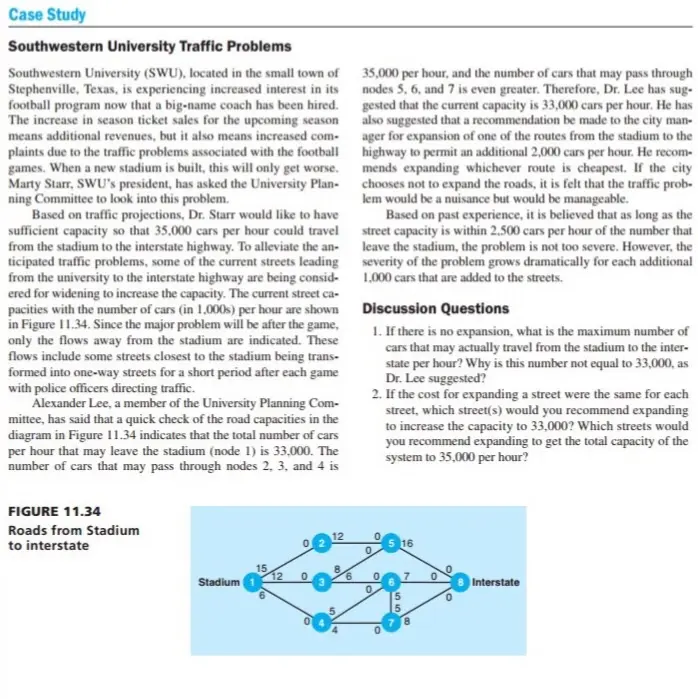
pacities with the number of cars (in 1,000s) per hour are shown
in Figure 11.34. Since the major problem will be after the game,
only the flows away from the stadium are indicated. These
flows include some streets closest to the stadium being trans-
formed into one-way streets for a short period after each game
with police officers directing traffic.
Alexander Lee, a member of the University Planning Com-
mittee, has said that a quick check of the road capacities in the
diagram in Figure 11.34 indicates that the total number of cars
per hour that may leave the stadium (node 1) is 33,000. The
number of cars that may pass through nodes 2, 3, and 4 is
35,000 per hour, and the number of cars that may pass through
nodes 5, 6, and 7 is even greater. Therefore, Dr. Lee has sug-
gested that the current capacity is 33,000 cars per hour. He has
also suggested that a recommendation be made to the city man-
ager for expansion of one of the routes from the stadium to the
highway to permit an additional 2,000 cars per hour. He recom-
mends expanding whichever route is cheapest. If the city
chooses not to expand the roads, it is felt that the traffic prob-
lem would be a nuisance but would be manageable.
Based on past experience, it is believed that as long as the
street capacity is within 2,500 cars per hour of the number that
leave the stadium, the problem is not too severe. However, the
severity of the problem grows dramatically for each additional
1,000 cars that are added to the streets.
Discussion Questions
1. If there is no expansion, what is the maximum number of
cars that may actually travel from the stadium to the inter-
state per hour? Why is this number not equal to 33,000, as
Dr. Lee suggested?
2. If the cost for expanding a street were the same for each
street, which street(s) would you recommend expanding
to increase the capacity to 33,000? Which streets would
you recommend expanding to get the total capacity of the
system to 35,000 per hour?
FIGURE 11.34
Roads from Stadium
to interstate
12
16
15
Stadium
Interstate
check_circle الجواب — حل مفصل خطوة بخطوة
hourglass_top
🔒
الحل الكامل متاح للمشتركين
اشترك في أرشيف الأسئلة لعرض هذا الحل وآلاف الحلول المفصلة خطوة بخطوة من معلمين معتمدين.