تم الحل ✓
categoryرياضيات
schoolبكالوريوس
event_available2026-07-13
السؤال
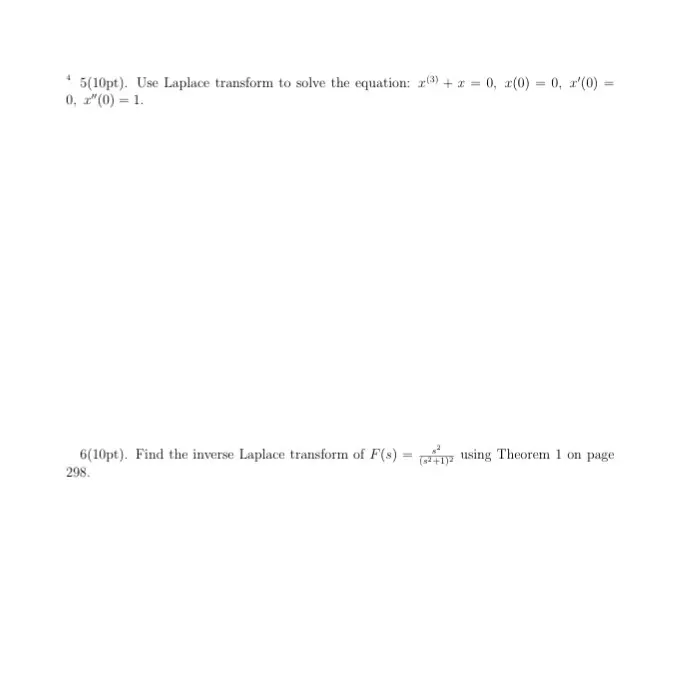
Transcribed Image Text:
4
5(10pt). Use Laplace transform to solve the equation: (3) + x = 0, x(0) = 0, '(0) =
0, "(0) = 1.
6(10pt). Find the inverse Laplace transform of F(s) = ( using Theorem 1 on page
298.
And we recall from Example 5 of Section 4.2 that the Laplace transform of sing
is indeed s/(s²+1)².
Theorem 1 is proved at the end of this section.
THEOREM 1 The Convolution Property
Suppose that f(f) and g(1) are piecewise continuous for 10 and that [f(t)\
and g(t) are bounded by Me as t+oo. Then the Laplace transform of the
convolution f(t)* g(t) exists for s > c; moreover,
A
L{f(t)g(1)) = L{f(t)} L{g(t)}
(4)
and
L{F(s) G(s)} = f(t) * g(t).
(5)
Thus we can find the inverse transform of the product F(s) G(s), provided
that we can evaluate the integral
L¹{F(s) G(s)}=
f(t)g(tt) dr.
(5')
Example 2 illustrates the fact that convolution often provides a convenient
alternative to the use of partial fractions for finding inverse transforms.
With f(t) = sin 21 and g(t) = e', convolution violdo
check_circle الجواب — حل مفصل خطوة بخطوة
hourglass_top
🔒
الحل الكامل متاح للمشتركين
اشترك في أرشيف الأسئلة لعرض هذا الحل وآلاف الحلول المفصلة خطوة بخطوة من معلمين معتمدين.