تم الحل ✓
categoryفيزياء
schoolبكالوريوس
event_available2026-07-13
السؤال
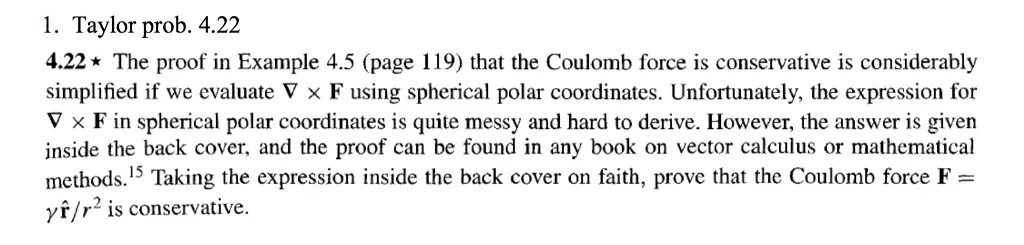
Transcribed Image Text:
1. Taylor prob. 4.22
4.22
The proof in Example 4.5 (page 119) that the Coulomb force is conservative is considerably
simplified if we evaluate V x F using spherical polar coordinates. Unfortunately, the expression for
VF in spherical polar coordinates is quite messy and hard to derive. However, the answer is given
inside the back cover, and the proof can be found in any book on vector calculus or mathematical
methods.15 Taking the expression inside the back cover on faith, prove that the Coulomb force F =
y/r2 is conservative.
Section 4.4 The Second Condition that F be Conservative
It can be shown (though I shall not do so here³) that a force F has the desired
property, that the work it does is independent of path, if and only if
V x F = 0
(4.36)
everywhere. The quantity V x F is called the curl of F, or just "curl F," or "del cross
F." It is defined by taking the cross product of V and F just as if the components
of V, namely (a/ax, a/ǝy, a/əz), were ordinary numbers. To see what this means,
consider first the cross product of two ordinary vectors A and B. In the table below, I
have listed the components of A, B, and A x B:
vector
x component
y component
Z component
Ax
Bx
Ay
By
Az
(4.37)
B₂
A
B
A x B A,B₂- AzBy
A₂Bx - AxB₂ AxBy - A,Bx
The components of V x F are found in exactly the same way, except that the entries
in the first row are differential operators. Thus,
vector
x component y component Z component
▼
F
д/дх
Fx
VXF
FF
д/ду
Fy
FF
a/az
(4.38)
F₂
F-Fx
No one would claim that (4.36) is obviously equivalent to the condition that
F.dr is path-independent, but it is, and it provides an easily applied test for the
path-independence property, as the following example shows.
119
check_circle الجواب — حل مفصل خطوة بخطوة
hourglass_top
🔒
الحل الكامل متاح للمشتركين
اشترك في أرشيف الأسئلة لعرض هذا الحل وآلاف الحلول المفصلة خطوة بخطوة من معلمين معتمدين.